

FDA and LFGB Certified Tempered Glass Lids: How to Source Compliantly from China in 2026
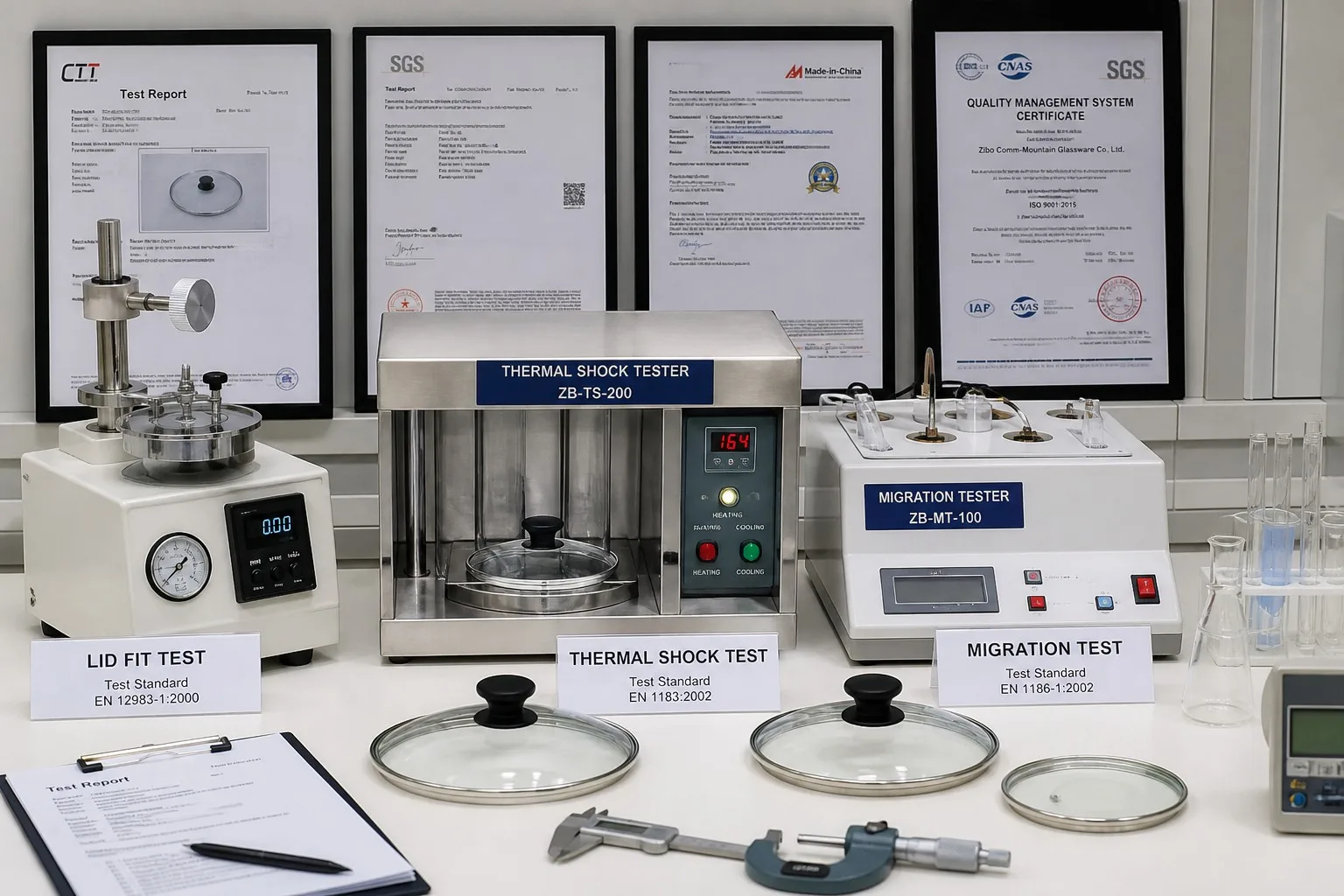
When a cookware brand requires a FDA LFGB certified glass lid manufacturer, the first challenge is understanding what these certifications actually mean — and what they do not. FDA and LFGB are not factory-level certificates issued once and held indefinitely. They are product-specific compliance frameworks, satisfied by third-party laboratory test reports on specific product configurations. A Chinese factory can hold current FDA food-contact documentation for one product family and be fully non-compliant on another. This guide explains how the compliance frameworks work, how to verify genuine documentation, and how to build a supply chain that passes customs inspection on first attempt.
1. What FDA 21 CFR Compliance Actually Means for Glass Lids
The US Food and Drug Administration (FDA) regulates food-contact materials under 21 CFR (Code of Federal Regulations). For FDA glass lid China sourcing, two sections are directly relevant:
- 21 CFR 177.2410 — Borosilicate glass-ceramics: Covers borosilicate glass compositions used in baking and oven-safe applications. Most standard tempered glass cookware lids use soda-lime glass rather than borosilicate, so this section is less commonly cited for standard stovetop lid applications.
- 21 CFR 177.2600 — Rubber articles intended for repeated use: This section is relevant when the lid includes a silicone or rubber sealing strip, knob gasket, or handle attachment that contacts food. For any Silicone-Rim lid or silicone knob component, FDA 21 CFR 177.2600 compliance documentation is required for US market clearance.
For the glass substrate itself (soda-lime tempered glass), FDA compliance is typically demonstrated through a compliance letter from the glass manufacturer citing the specific raw material composition and confirming it meets FDA food-contact requirements. This is distinct from a third-party laboratory test report — it is a manufacturer's declaration, and its validity depends on the accuracy of the composition data.
The practical implication: for US retail buyers, request both the glass substrate compliance letter AND, if any silicone/rubber components are present, a third-party migration test report for those components under 21 CFR 177.2600. A compliance letter alone for silicone components is not sufficient for major US retail buyers.
2. LFGB §31 Compliance: The EU Standard That Requires Third-Party Testing
Germany's Lebensmittel-, Bedarfsgegenstände- und Futtermittelgesetzbuch (LFGB) §31 is the primary food-contact materials regulation for cookware imported into Germany and, by extension, the EU market. Unlike FDA compliance letters, LFGB §31 compliance for glass lids and their metal rim components requires independent laboratory migration testing.
| Component | LFGB §31 Test Method | Key Migration Limits | Typical Cost (SGS/Intertek) |
|---|---|---|---|
| Glass substrate (soda-lime) | DIN EN 1388-2 (lead/cadmium leaching) | Pb ≤ 0.8 mg/dm²; Cd ≤ 0.07 mg/dm² | €180–280 |
| Stainless steel rim (304 grade) | EN 1811 (nickel release); DIN 10531 | Ni release ≤ 0.5 µg/cm²/week | €220–350 |
| Silicone sealing ring / knob | BfR Recommendation XV; overall migration | Overall migration ≤ 60 mg/kg | €280–420 |
For an LFGB cookware lid supplier to provide a complete compliance package for a standard stainless-rim lid with silicone knob, all three test categories above must be covered. The total laboratory cost is typically €680–1,050 per product configuration, amortised across production volume. A factory producing 200,000 units annually of a given configuration adds approximately €0.003–0.005 per unit in LFGB testing cost — a real but minor contribution to the total FOB price.
Important: LFGB test reports are product-specific. A report covering a 26 cm C-Series lid with 304 steel rim and silicone knob does NOT cover a 28 cm lid with the same configuration — the report must be repeated for each distinct diameter or when any material specification changes.
3. Verifying Genuine Compliance Documentation
The most common compliance documentation failure in China-sourced cookware lids is the presentation of outdated, incorrectly scoped, or fabricated test reports. Three verification steps that take less than 10 minutes and catch the majority of documentation problems:
- Check the testing laboratory accreditation: Legitimate LFGB and FDA migration test reports come from DAkkS-accredited (Germany) or A2LA/ILAC-accredited (international) laboratories. SGS, Intertek, Bureau Veritas, and TÜV Rheinland are the primary labs used by Fenghua factories. Verify the lab name and accreditation number on the cover page against the lab's public accreditation register. Reports from unrecognised labs or without an accreditation number are not acceptable.
- Verify product scope against your specification: The test report's product description section must match your specification. Check: material (glass type, steel grade), configuration (rim type, knob material), and size (if size-specific). Mismatches between the tested product and the product you are buying invalidate the report for your purposes.
- Check the test date: For LFGB §31 compliance, industry standard is report renewal every 2 years or upon any material specification change. A test report dated more than 2 years ago should be questioned, particularly if raw material prices shifted significantly in the intervening period (which can drive material substitutions).
4. Boyu Glass: Compliance Documentation Ready Within 3 Business Days
Boyu Glass (glasslidfactory.com) maintains current LFGB §31 test reports (SGS Ningbo) and FDA food-contact compliance letters for all standard product configurations in our C-Series, G-Narrow, G-Wide, and Silicone-Rim ranges. Documentation packages — including test report cover pages, scope sections, and accreditation details — are available to qualified buyers within 3 business days of inquiry. Our BSCI social compliance audit is renewed annually. MOQ is 1,000 pieces; FOB Ningbo lead time is 45 days from confirmed PO.
Frequently Asked Questions
Does a Chinese factory's business licence or ISO 9001 certification prove FDA or LFGB compliance?
No. A business licence proves the factory is legally registered; ISO 9001 certifies that the factory operates a quality management system. Neither provides food-contact compliance documentation for the specific products being manufactured. FDA and LFGB compliance requires product-specific laboratory test reports, not factory-level management system certificates. Do not accept one as a substitute for the other.
Is it sufficient to obtain LFGB compliance for the German market and assume it covers all EU countries?
LFGB §31 is the German national implementation of EU Regulation 1935/2004 (Framework Regulation on food-contact materials). In practice, LFGB-compliant products generally satisfy the food-contact requirements across EU member states. However, some EU countries have additional national regulations for specific material categories. For the UK market post-Brexit, the applicable framework is the UK Food Contact Materials Regulations 2019, which largely mirrors EU requirements but should be verified for specific product categories. Always check with your import agent for the specific target market requirements.
What happens if a glass lid shipment arrives without the required compliance documentation?
Customs authorities in the EU and US can request food-contact compliance documentation at the port of entry. Without valid documentation, goods may be held for laboratory testing (at importer's cost and risk), refused entry, or detained pending documentation provision — all of which cause supply chain delays and additional costs. Major retail buyers in the EU and US also conduct their own documentation audits at goods receipt and will return shipments from suppliers who cannot provide current, in-scope compliance documentation.
Related B2B Sourcing Guides
Continue reading on related sourcing topics for cookware brands and importers:
Conclusion
Three key takeaways for procurement teams sourcing FDA and LFGB certified tempered glass lids from China:
- Compliance is product-specific, not factory-specific. A factory's overall compliance history does not guarantee that any given product configuration is covered by current, valid test reports. Always request and verify the specific test report that covers your exact product specification — material, configuration, and size.
- Third-party laboratory accreditation is non-negotiable. LFGB §31 migration test reports from non-accredited laboratories are not accepted by EU customs or major retail buyers. Verify the testing laboratory against the DAkkS or ILAC accreditation register before accepting any compliance documentation.
- Build compliance verification into the purchase order, not the QC inspection. By the time goods reach the port for pre-shipment inspection, it is too late to address documentation gaps. Include compliance documentation as a purchase order condition with a specified delivery timeline (e.g., current LFGB test reports within 5 business days of PO confirmation).
Ready to source factory-direct? Request a free quote within 24 hours: aman098@126.com or visit glasslidfactory.com