

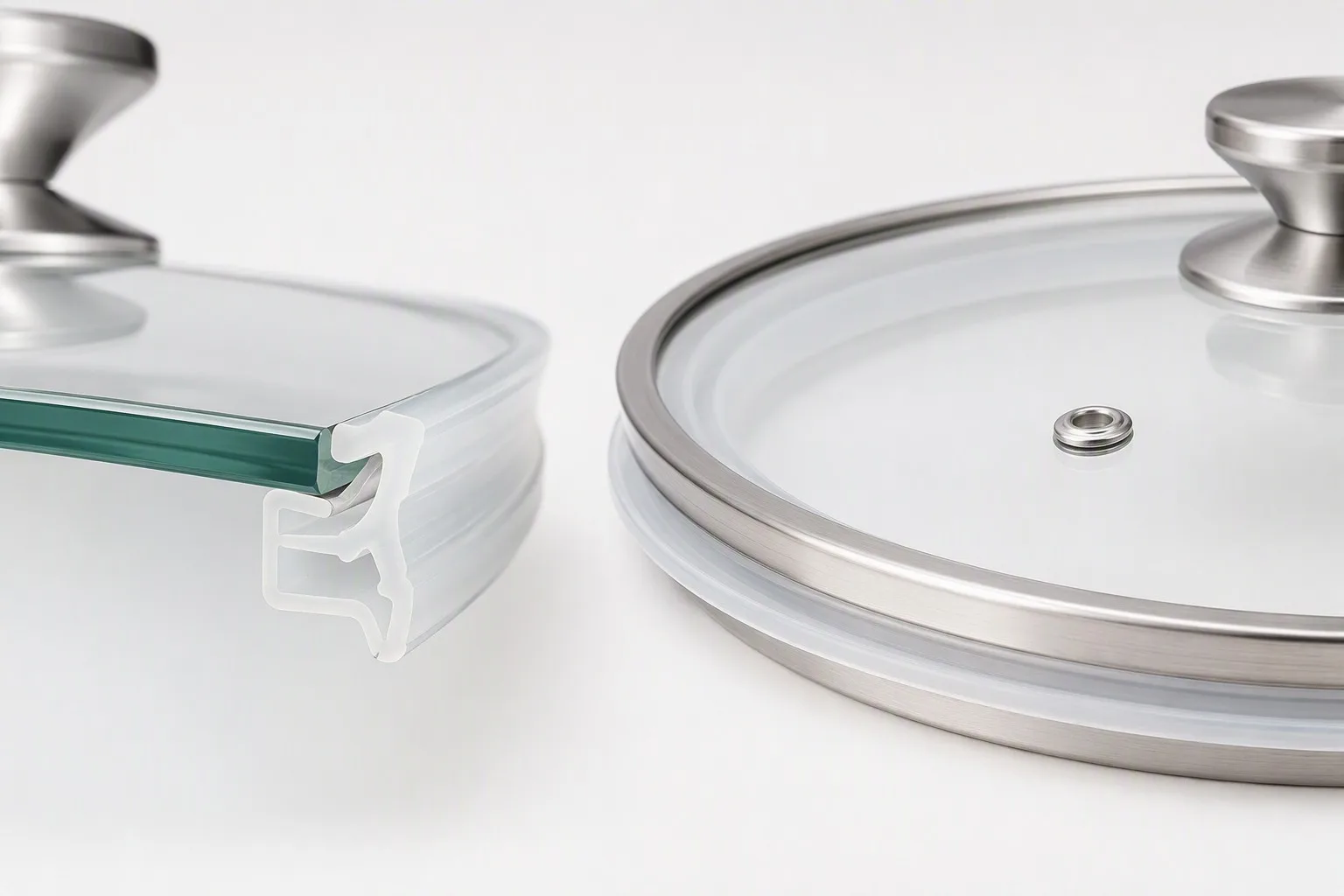
Food-Grade Silicone Gaskets for Glass Lids: OEM Specification Guide — 2026 Edition
The silicone gasket glass lid OEM specification is one of the most frequently incomplete elements in glass lid procurement briefs. Buyers often specify the glass disc diameter and rim type correctly but omit the silicone gasket parameters — only to receive a quotation that defaults to the factory's standard gasket, which may not meet the compliance requirements of the destination market or the sealing performance requirements of the end product. This guide covers the technical specification fields that determine silicone gasket selection for OEM glass cookware lids: hardness range, profile type, certification requirements, bonded versus removable configurations, and colour and material options. The specifications apply to Boyu Glass's Silicone-Rim product line and to silicone gasket elements used in G-Narrow and G-Wide metal-rim configurations.
Silicone Hardness, Profile Type, and Dimensional Specification
Specifying an 8mm silicone rim glass lid or any other silicone-rim configuration requires three dimensional parameters in addition to the glass diameter: the gasket width (cross-section), the gasket profile, and the Shore A hardness.
Shore A hardness is the most commonly misunderstood specification in silicone rim glass lid OEM briefs. Silicone gaskets for cookware lids are typically formulated in the Shore A 40–70 range:
- Shore A 40–50 (soft): Higher compressibility, better conformance to irregular surfaces, more forgiving of lid-to-pan tolerance variation. Common in consumer cookware applications where a visible, tactile soft-touch rim is part of the product design. More susceptible to deformation under sustained pressure loading.
- Shore A 55–65 (medium, most common for OEM): Balances seal conformance with dimensional stability. Maintains gasket profile under repeated thermal cycling. Standard specification for most cookware brands sourcing from Fenghua factories. This range is compatible with most pan rim geometries for standard round lids.
- Shore A 65–70 (firm): Higher rigidity, lower compressibility, better resistance to extrusion under pressure. Required for some pressure cooker and multi-cooker applications where the gasket must resist deformation under elevated internal pressure. Requires more precise lid-to-pan tolerance control to achieve effective sealing at this hardness.
Gasket profile refers to the cross-sectional shape of the silicone element. The most common profiles in glass lid applications are:
- Flat lip seal: Gasket lies flush against the pan rim in a flat orientation. Simple geometry, easy to tool, lowest cost. Adequate for standard atmospheric-pressure cooking applications.
- Inward-angled lip seal: Gasket angles inward at the contact surface, increasing sealing force as steam pressure rises. More effective than a flat seal for self-sealing lid designs. Requires more precise gasket cross-section tolerancing.
- D-profile / O-profile: Round or D-shaped cross-section that deforms uniformly under compression. Used in some premium cookware designs where the gasket is intended to be visible as a design element and must maintain consistent visual profile across the lid circumference.
Gasket width (commonly 6 mm, 8 mm, or 10 mm across the contact face) should be specified to match the pan's rim width at the contact zone. An 8 mm gasket on a pan designed for a 6 mm contact zone will result in overhang that compromises seal geometry.
FDA and LFGB Compliance: Certification Options and Documentation
For food grade silicone cookware lid factory orders destined for regulated markets, the silicone formulation must comply with the food-contact material regulations of the destination market. The two most commonly required certifications are:
| Specification | FDA 21 CFR 177.2600 (USA) | LFGB §30/31 (EU/Germany) |
|---|---|---|
| Scope | Rubber articles for repeated use in food contact in the US | Food, commodities, consumer goods and feed code (Germany); widely adopted as EU food-contact standard for cookware |
| What is tested | Extraction limits for regulated substances in silicone at specified temperatures and food simulants | Volatile siloxane migration levels; overall migration limit in food simulants at specified temperature/time conditions |
| Test report format | Third-party lab report confirming compliance with 21 CFR 177.2600 extractables and specific substance limits | Test report from accredited laboratory; declaration of compliance from manufacturer referencing the formulation tested |
| Applies to formulation or batch? | Formulation — report valid for the tested silicone compound; colour changes or filler additions may require retesting | Formulation — same caveat applies; colour masterbatch must also be tested for compliance |
| Validity | No formal expiry; buyers typically request reports no older than 3-5 years | No formal expiry for formulation compliance; buyers typically request current reports |
| Common for | US, Canada, and markets that recognise FDA compliance | EU, UK (post-Brexit recognises LFGB), and markets that use EU standards |
When placing an OEM order that requires both FDA and LFGB compliance, state this requirement in the RFQ at the outset. Some Fenghua factories maintain silicone formulations certified to both standards; others maintain separate compounds for each market. The factory's compliance documentation should specify the exact silicone compound reference number that the test report covers — this allows the buyer to verify that the compound used in production matches the tested formulation.
BSCI and Sedex audit coverage applies to the factory's social compliance, not to the silicone material itself. For orders requiring both material compliance and social compliance documentation, confirm that the factory holds a current audit certificate covering the production site.
Boyu Glass Factory Direct Advantage
Boyu Glass (glasslidfactory.com) manufactures Silicone-Rim glass lids with food-grade silicone gaskets available in Shore A 45–65 hardness range, multiple profile options (flat lip and inward-angled lip), and standard widths of 6 mm, 8 mm, and 10 mm. Silicone formulations are available with FDA 21 CFR 177.2600 compliance documentation and LFGB §30/31 test reports from accredited third-party laboratories. Gasket colours: standard transparent, black, red, and grey; custom colours available with minimum order confirmation. Bonded and removable gasket configurations available depending on product design requirement. MOQ 1,000 pcs per SKU; lead time 45 days FOB Ningbo.
Frequently Asked Questions
Can the silicone gasket colour be customised without re-testing for compliance?
Colour changes require re-evaluation of the silicone formulation's food-contact compliance, because colour masterbatches introduce additional chemical substances that may affect migration limits. In practice, reputable factories maintain compliance test reports for each colour offered in their standard range. If you require a custom colour not in the standard range, the factory must either confirm that the same colour masterbatch has been tested within the existing formulation, or arrange a new compliance test. This adds time and cost — typically several weeks — to the sampling and approval process. Buyers should confirm the available tested colours at the RFQ stage to avoid post-order surprises.
What is the difference between a bonded and a removable silicone gasket from an OEM specification perspective?
A bonded gasket is permanently adhered to the lid rim and cannot be detached without damaging the gasket. A removable gasket is mechanically retained in a channel in the rim and can be removed by the end user for cleaning. From an OEM specification perspective, the key differences are: (1) a removable gasket requires a rim channel geometry that the factory must accommodate in the rim tooling — this is a design constraint that should be confirmed before tooling is committed; (2) removable gaskets typically require a slightly firmer durometer to maintain their position in the channel during normal use; (3) bonded gaskets simplify production but may limit the product's appeal in markets where user-removable gaskets are a selling point. The choice should be driven by the end product's use context and the buyer's target market preference.
Does the silicone gasket specification affect the thermal shock test performance of the glass lid?
The thermal shock test assesses the tempered glass disc's resistance to rapid temperature change — it is a glass property test, not a gasket test. The silicone gasket is typically not the subject of the thermal shock test. However, the gasket's dimensional stability at temperature extremes is relevant to the assembled product's performance: a gasket that shrinks or deforms significantly at high temperatures may compromise the seal after thermal cycling. Buyers specifying lids for high-temperature applications (such as oven use) should confirm the silicone formulation's rated operating temperature range with the factory. Standard food-grade silicone is rated for continuous use up to 200–230°C — verify this against the specific formulation used in your OEM order.
Related B2B Sourcing Guides
Continue reading on related sourcing topics for cookware brands and importers:
Conclusion
Three specification decisions that have the most impact on silicone gasket OEM outcomes for glass cookware lids:
- State Shore A hardness, not just material type. Specifying food-grade silicone without a hardness range leaves the factory to default to its standard compound, which may not match the sealing performance or tactile requirement of your end product. Shore A 55–65 is the most widely applicable range for standard cookware; specify harder for pressure applications and softer for decorative-tactile designs.
- Confirm compliance requirements before sampling. FDA and LFGB compliance attach to the silicone formulation, not to the production batch. If you specify the compliance requirement after samples have been made with an uncertified formulation, re-sampling with a compliant compound adds lead time and sample cost. State compliance requirements in the RFQ and confirm the factory's existing certified formulations before approving sample production.
- Decide bonded vs removable at the tooling stage. Changing from a bonded to a removable gasket configuration after rim tooling is committed requires tooling modification or new tooling. The decision should be made before tooling deposit is paid — treat it as a mandatory specification field, not an afterthought.
Ready to source factory-direct? Request a free quote within 24 hours: aman098@126.com or visit glasslidfactory.com