

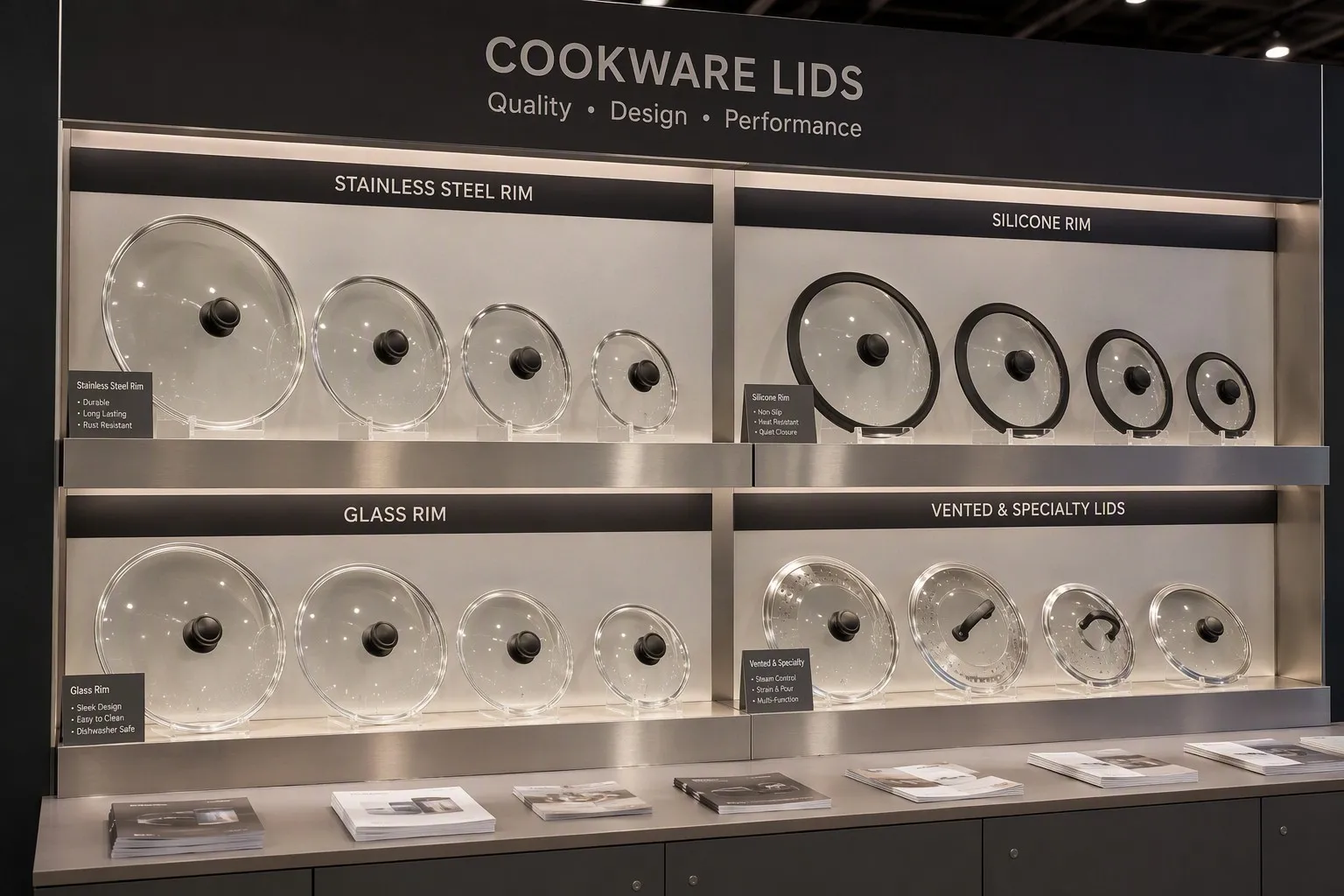
Glass Lid in China: The Complete Buyer's Guide to Factories, Clusters and Sourcing Strategy — 2026 Edition
Sourcing a glass lid in China is a supply chain decision that affects product quality, landed cost, compliance exposure, and brand integrity for every order. China dominates global production of tempered glass cookware lids, concentrated in a small number of manufacturing clusters. A buyer who understands the cluster geography, supplier types, and certification requirements can make a well-informed decision without visiting every factory. This guide covers the industrial geography of Chinese glass lid production, the structural differences between main supplier categories, the compliance documentation framework, and the strategic questions that determine which sourcing approach suits your volume and product requirements.
Manufacturing Clusters: Where Glass Lids in China Are Made
Production of made in China glass lids is geographically concentrated. The dominant cluster is in Fenghua District, Ningbo, Zhejiang Province — a vertically integrated supply chain for tempered glass cookware lids developed over several decades. Within this cluster, raw float glass suppliers, tempering furnace operators, stainless rim stamping workshops, silicone gasket producers, and finished lid assembly factories operate in close proximity. This reduces component lead times and enables short production cycles for standard configurations.
A secondary cluster in Guangdong Province's Pearl River Delta focuses on export-oriented consumer cookware packaging. Smaller production centres in Shandong and Hebei typically serve the domestic Chinese market with lower-specification products.
For international buyers, the Ningbo cluster is the primary source for export-quality tempered glass lids: the port of Ningbo-Zhoushan is one of China's largest container terminals, providing competitive freight rates; the cluster has the deepest concentration of FDA/LFGB-certified suppliers; and factory-level OEM capability is most developed here.
Supplier Types: Factory Direct vs Trading Company vs Agent
Buyers sourcing China glass lid wholesale will encounter three main supplier structures. Understanding the differences before entering negotiations prevents misaligned expectations on pricing, MOQ, lead time, and customisation capability.
| Supplier Type | Structure | MOQ range | OEM capability | Best for |
|---|---|---|---|---|
| Factory direct | Manufactures on-site; owns tempering furnace and assembly line | 1,000–3,000 pcs per SKU | Full OEM: diameter, rim, print, packaging | Defined specs, mid-to-large volume |
| Trading company | Sources from multiple factories; adds margin layer; handles documentation | 300–1,000 pcs (mixed SKUs) | Limited; depends on sourcing factory | Low MOQ or multi-product mix |
| Sourcing agent | Represents buyer; earns commission; no inventory | Depends on assigned factory | Variable | First-time buyers needing coordination |
Factory-direct supply is the structure most cookware and appliance OEM buyers target for ongoing production. It eliminates the trading margin, enables direct technical communication on specification changes, and places quality accountability with the manufacturer. The tradeoff is higher MOQ and direct supplier relationship management.
Compliance Documentation for Glass Lids from China
A glass lid imported into the EU, US, UK, or major Australasian markets requires specific compliance documentation. Require the following at the sample stage — not after production placement:
- FDA 21 CFR compliance (US market): Silicone gaskets must comply with FDA 21 CFR 177.2600. Request the specific test report referencing the silicone compound in your product, not a generic company-level certificate.
- LFGB §30/31 (EU/German market): Request the LFGB §30/31 migration test report issued by an accredited third-party laboratory for the specific silicone formulation used.
- BSCI or Sedex audit: A current certificate (within 12 months) covering the specific factory site. Verify the audit scope covers the manufacturing address.
- Thermal shock test record: A sample batch test record demonstrating systematic monitoring of this safety-critical parameter.
Boyu Glass Factory Direct Advantage
Boyu Glass (glasslidfactory.com) is a factory-direct supplier in the Fenghua, Ningbo cluster, operating since 2001. Product lines: C-Series stainless-rim round lids, G-Narrow and G-Wide universal stainless-rim lids, Silicone-Rim appliance lids. Current FDA and LFGB compliance documentation available; BSCI certified. MOQ: 1,000 pcs per SKU. Lead time: 45 days FOB Ningbo. Full OEM: custom diameter, rim configuration, print, and packaging. Sample lead time: 7–10 working days.
Frequently Asked Questions
What is the minimum order quantity for a glass lid from a Chinese factory?
Factory-direct suppliers in the Ningbo cluster typically set 1,000 to 3,000 pieces per SKU for standard configurations, and higher for specifications requiring dedicated tooling. Trading companies can often accommodate 300 to 500 pieces for a mixed SKU order. If your volume is below 1,000 pieces per SKU, a trading company or a factory with a small-run programme is the more practical route until volume justifies factory-direct pricing.
How do I verify that a Chinese glass lid factory manufactures on-site rather than reselling?
Request a factory audit — in person or via a third-party inspection company. Key indicators: a functioning tempering furnace on-site, in-process quality records with batch traceability, and production staff present. Verify the business licence scope includes glass product manufacturing. A factory unable to demonstrate on-site tempering capability is likely an assembly operation or trading company, regardless of how it describes itself.
What lead time should I expect from order to FOB shipment?
Standard configurations without custom tooling: 30 to 45 calendar days FOB Ningbo. Custom diameter, rim, or print tooling adds 10 to 20 days. If pre-production sample approval is required, add 7 to 10 working days for sample production plus your internal review cycle before production can begin.
Related B2B Sourcing Guides
Continue reading on related sourcing topics for cookware brands and importers:
Conclusion
- Geography determines sourcing options. The Ningbo/Fenghua cluster is the primary source for export-quality, OEM-capable tempered glass lids with the deepest concentration of FDA/LFGB-certified factory-direct suppliers.
- Supplier structure determines pricing, MOQ, and accountability. Factory-direct eliminates the trading margin and places technical accountability with the manufacturer, but requires meeting per-SKU minimums. Trading companies offer flexibility at lower volumes with an added cost layer.
- Compliance documentation is a procurement requirement, not an afterthought. FDA, LFGB, and BSCI documentation unavailable at sample stage will not materialise under production pressure. Establish requirements in writing before the first sample is ordered.
Ready to source factory-direct? Request a free quote within 24 hours: aman098@126.com or visit glasslidfactory.com