

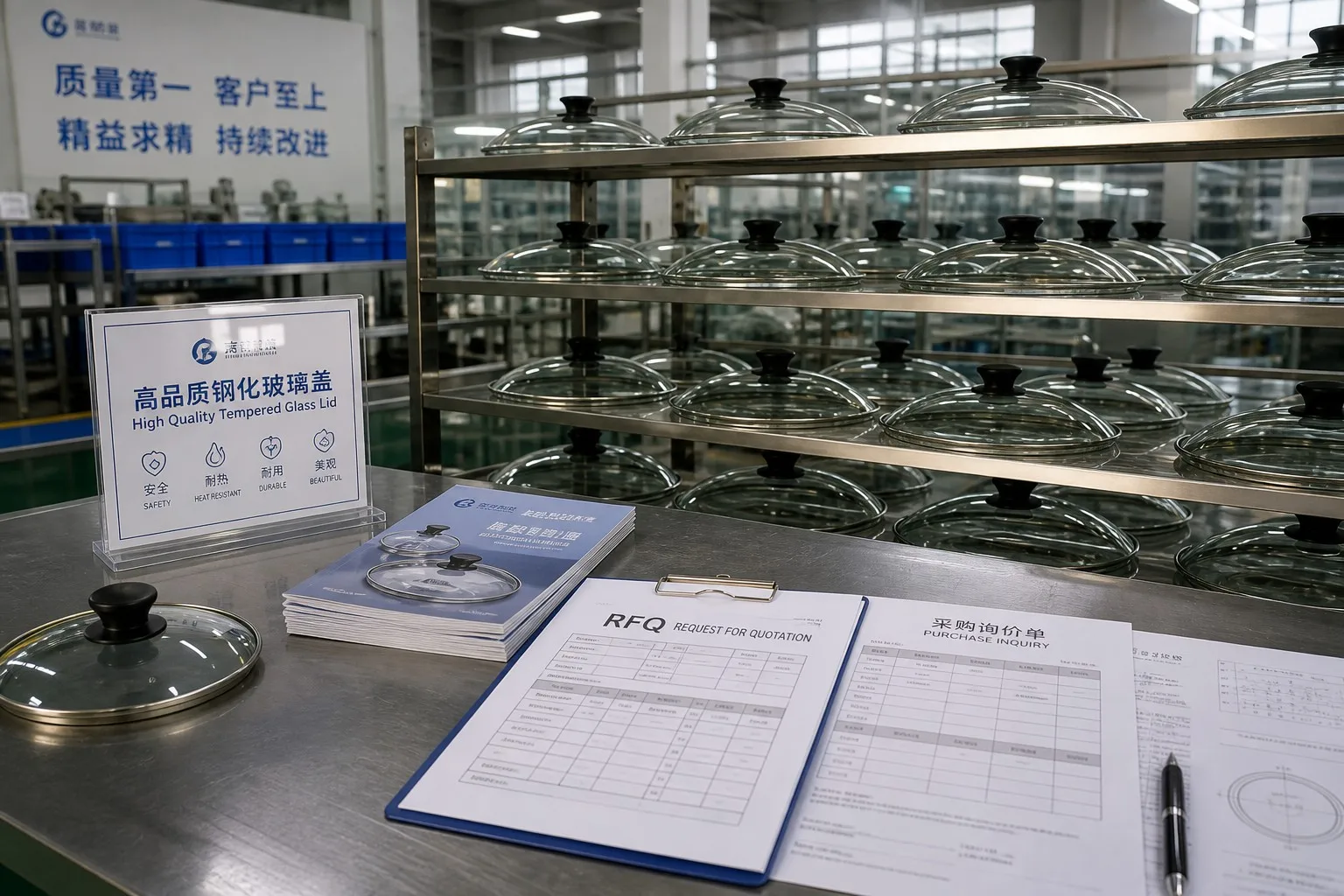
How to Write an Effective RFQ for Tempered Glass Lids: Template and Factory Tips — 2026 Guide
Related B2B Sourcing Guides
Continue reading on related sourcing topics for cookware brands and importers:
A well-structured glass lid RFQ factory China request significantly reduces the number of clarification rounds between buyer and factory, compresses the time to a usable price, and gives procurement teams a more accurate base for cost comparison. Most RFQs received by Chinese glass lid factories are missing three to five critical specification fields that are required before quoting can begin — which means the factory either sends a price range too wide to be useful, or spends several days requesting information that should have been in the original inquiry. This guide covers the required specification fields for a tempered glass cookware lid RFQ, common mistakes that slow the quoting process, factory response time expectations, and a structured template you can adapt for your next inquiry.
Required Specification Fields: What Every Glass Lid RFQ Must Include
When sending a request quote glass lid inquiry to a Chinese manufacturer, the following fields determine whether the factory can return a firm price or only a preliminary estimate. Missing fields in bold italic are the most frequent source of quoting delays.
- Glass disc diameter — Specify in millimetres with tolerance (e.g. 240 mm ±0.5 mm). If you are sourcing to fit existing pan tooling, include the pan's internal rim diameter and whether a groove is present.
- Glass thickness — Standard cookware lid glass is 4 mm. Pressure cooker and multi-cooker applications typically require 5 mm. Specifying the wrong thickness affects tempering parameters and cost.
- Rim type and material — Specify G-Narrow, G-Wide, C-Series (with fixed diameter), or Silicone-Rim. For metal-rim configurations, specify 304 stainless, aluminium, or other. Surface finish (brushed, polished, painted) must also be stated.
- Knob type — Material (phenolic, stainless steel, silicone-grip, bakelite), colour, and whether a hole exists in the knob for steam venting.
- Silicone gasket — Required or not. If required: colour, food-contact certification required (FDA, LFGB, or both), and whether the gasket is removable or bonded.
- Logo and marking requirements — Silk-screen, laser engraving, or none. If silk-screen: pantone colour, position, and approximate coverage area. Logo files should be attached to the RFQ in vector format.
- Packaging specification — Retail box, OPP bag, bulk carton, or custom packaging. Include retail barcode requirement if applicable.
- Order quantity — Total quantity and breakdown by size if multi-diameter. This determines whether the factory quotes at MOQ pricing or volume pricing.
- Target delivery date or lead time — Required to identify whether the order falls within standard production scheduling or requires rush handling (which carries a cost premium).
- Destination port — For FOB pricing, the departure port (typically Ningbo) is assumed; the buyer's destination port determines freight cost estimates if CIF pricing is requested.
- Compliance requirements — List required certifications: FDA, LFGB, BSCI, Sedex, or other. Some certifications require pre-production material approval, which affects timeline.
A complete RFQ containing all of the above fields should take a factory 1-3 business days to respond with a firm quotation. An incomplete RFQ typically triggers a clarification email that adds 3-7 days to the quoting cycle before a price is available for comparison.
Common RFQ Mistakes and Factory Response Time by Inquiry Type
Understanding glass lid supplier response time expectations helps procurement teams set realistic timelines for the quoting stage. The table below compares response times for different RFQ quality levels and includes the most common mistakes that cause delays:
| RFQ Type | Typical Response Time | Common Issue | Impact on Price Accuracy |
|---|---|---|---|
| Complete RFQ (all fields) | 1-3 business days | None — factory can quote immediately | High — firm price, ready to compare |
| Partial RFQ (missing rim type or qty) | 5-10 business days | Clarification round required before quoting | Medium — price range, not firm |
| Vague inquiry (only size and material) | 7-14 business days or no response | Multiple clarification rounds; factory may deprioritise | Low — indicative only, large range |
| Sample request without spec | Variable — may require spec confirmation first | Factory cannot produce a sample without diameter and rim type | N/A — sample stage, not quote stage |
| RFQ with OEM logo and custom packaging | 3-5 business days | Logo file format wrong or pantone not specified | Medium — OEM setup cost variable until artwork confirmed |
The most common single mistake in glass lid RFQs is omitting the rim type. A factory cannot quote without knowing whether the buyer wants a G-Narrow, G-Wide, C-Series, or Silicone-Rim configuration, because each requires different rim tooling and assembly time. The second most common mistake is specifying quantity as a range without a firm commitment quantity — for example, "500-2,000 pcs" — which prevents the factory from applying the correct pricing tier. MOQ for most Fenghua factories is 1,000 pcs per SKU; quantities below MOQ attract a small-order surcharge that should be factored into the landed cost comparison.
Compliance Documentation and RFQ Quality Requirements
When the RFQ specifies FDA or LFGB compliance, procurement teams should include the following in the inquiry to avoid documentation delays after the order is placed:
- Silicone gasket certification: State whether FDA 21 CFR or EU LFGB (or both) is required. The specific silicone formulation used determines which certification applies. If the factory needs to switch to a certified formulation different from their standard, this should be confirmed before the order price is finalised.
- BSCI / Sedex / audit requirements: If social compliance audit is a requirement, state this in the RFQ so the factory can confirm current audit status. A BSCI audit certificate typically has a 2-year validity; buyers should request the most recent report date and coverage scope.
- Third-party inspection: State whether a pre-shipment inspection (PSI) by a named third-party inspection company is required. This does not affect the factory's quotation price, but it affects production scheduling — the factory needs to plan for the inspection window before carton sealing.
- Thermal shock test documentation: If the destination market requires performance test records, state the test standard protocol or ask for the factory's standard thermal shock test report format as part of the sample approval stage.
Boyu Glass Factory Direct Advantage
Boyu Glass (glasslidfactory.com) responds to complete glass lid RFQs within 1-2 business days from Fenghua, Ningbo. The quoting team covers all four product configurations — C-Series, G-Narrow, G-Wide, and Silicone-Rim — under the same roof, with in-house rim stamping, tempering, and QC. Since 2001, the factory has handled OEM inquiries for buyers across the EU, North America, and Asia Pacific. Standard documentation package: material compliance certificates, thermal shock test records, and BSCI audit coverage. MOQ 1,000 pcs per SKU; standard lead time 45 days FOB Ningbo.
Frequently Asked Questions
Should I send a sample product instead of written specifications in my RFQ?
A physical sample is useful for confirming the desired product profile, but it does not replace a written specification for quoting purposes. The factory needs a written spec to confirm diameter tolerance, glass thickness, rim material grade, and compliance requirements. If you have an existing lid you want to replicate, send both the sample and a written RFQ that documents the specifications you have measured from it. This prevents the factory from assuming a specification from the sample that differs from your actual requirement.
How should I handle RFQs for multiple sizes within the same product line?
List each diameter as a separate line item in the RFQ, with individual quantity requirements. If the same rim type, knob, and gasket apply to all sizes, state that once as a general specification rather than repeating it per line. If any size requires a different specification (for example, a larger diameter requiring 5 mm glass instead of 4 mm), note the exception clearly. Many buyers also find it useful to include a summary table at the top of the RFQ showing size, quantity, and any per-size variation, followed by the shared specification block below it.
What should I do if the factory's quoted price is significantly higher than expected?
Before concluding that the price is uncompetitive, verify that the specification you requested matches what you actually need. Overspecification is a common cause of unexpectedly high quotes — for example, requesting 5 mm glass when 4 mm is adequate for your application, or requesting polished stainless when brushed is acceptable for the end product. A second common cause is a low quantity relative to tooling setup cost: at quantities near MOQ, tooling amortisation has a larger impact on unit price than at higher volumes. Ask the factory to provide a breakdown of the price components, which will allow you to identify whether the price gap is driven by materials, tooling, or labour, and to compare meaningfully across multiple supplier quotes.
Related B2B Sourcing Guides
Continue reading on related sourcing topics for cookware brands and importers:
Conclusion
Three key takeaways for procurement teams preparing a glass lid RFQ for China factory sourcing:
- Include rim type as a mandatory field. Omitting the rim configuration (G-Narrow, G-Wide, C-Series, or Silicone-Rim) is the single most common cause of quoting delays. Without this field, the factory cannot price the job or identify the correct tooling — add it to every RFQ template before sending.
- State a firm quantity, not a range. A quantity range prevents the factory from applying the correct pricing tier. Use the intended initial order quantity as the quoted quantity; if you plan to place repeat orders, mention this context separately so the factory can consider relationship pricing, but do not use a projected total volume as the basis for unit price comparison.
- Front-load compliance requirements. Stating FDA, LFGB, BSCI, or PSI requirements in the RFQ rather than after the order is placed avoids mid-production specification changes that delay shipment and add cost. A factory that cannot meet your compliance requirements should be identified at the quoting stage, not after tooling deposit is paid.
Ready to source factory-direct? Request a free quote within 24 hours: aman098@126.com or visit glasslidfactory.com