

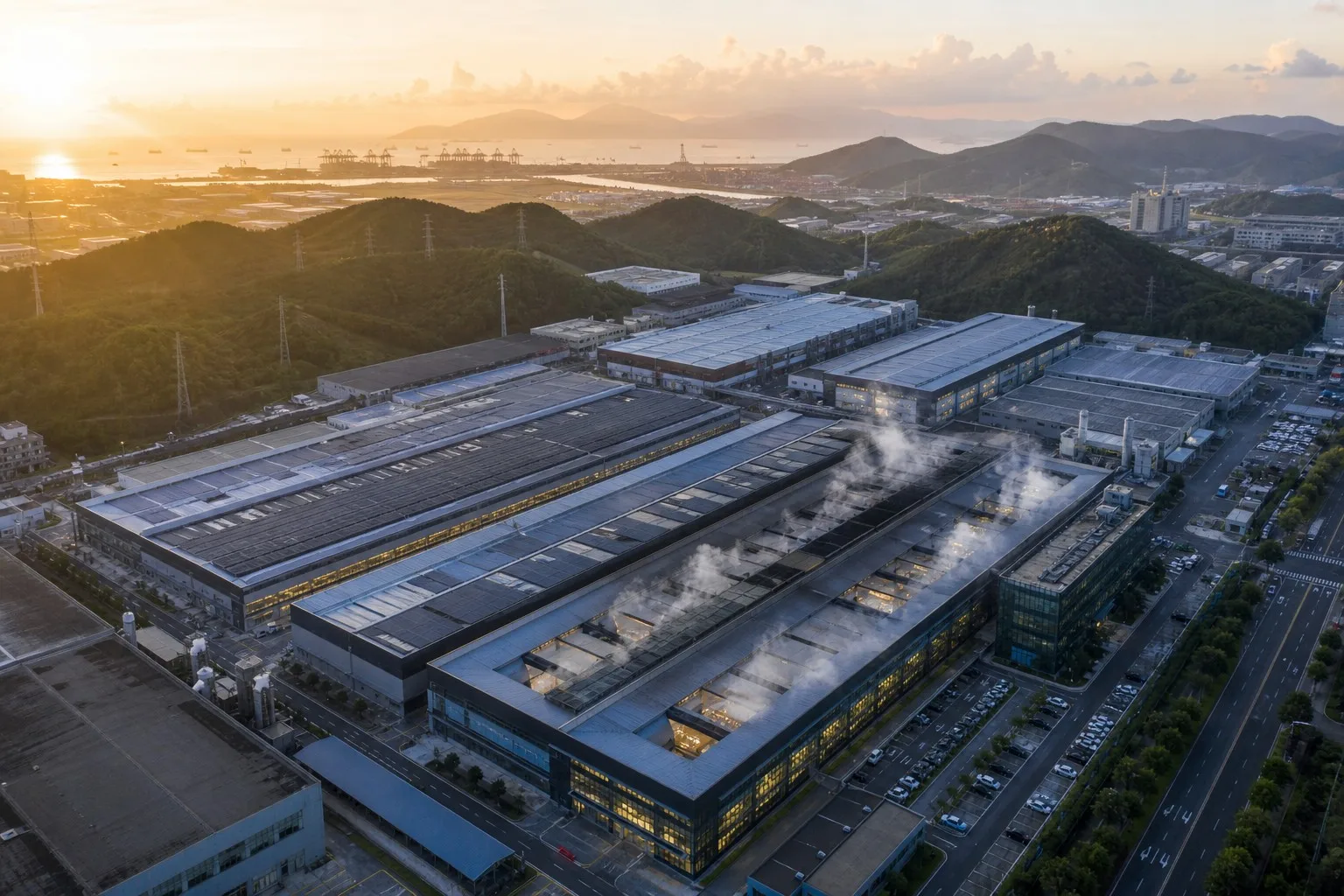
When a cookware brand in Germany, the United States, or Australia places an order for tempered glass lids, there is a high statistical probability that those lids originate within a 30-kilometre radius of one city: Ningbo, Zhejiang Province, China — and more specifically, its Fenghua District. This is not coincidence. It is the outcome of four decades of deliberate industrial clustering, supply chain co-evolution, and government-backed specialisation.
This report provides a data-grounded explanation of why Fenghua has become the global epicentre of tempered glass cookware lid manufacturing, what that concentration means for importers negotiating sourcing strategy in 2026, and how to extract maximum value from this geography while managing its inherent risks.
1. The Scale of Fenghua's Dominance
Industry estimates from the China Cookware Industry Association and provincial export statistics consistently place Ningbo (primarily Fenghua and Yuyao sub-districts) at 65–75% of China's total tempered glass lid export volume by piece count. By value, the share is slightly lower — approximately 60% — because higher-specification OEM lids with custom rims and multi-layer coatings also come from specialised factories in Guangdong and Jiangsu.
Within Fenghua itself, the glass-processing industrial zone at Shankou Township hosts the highest density of factories. A 10-kilometre corridor along National Highway G235 contains:
- Over 40 active tempered glass lid production facilities
- 12+ specialised rim-stamping sub-suppliers (stainless steel and aluminium)
- 6 silicone-ring compounding and moulding workshops
- 3 regional freight consolidators with direct Ningbo Port access
This geographic compression creates a supply chain that can complete a full production cycle — raw glass cutting, tempering, rim crimping, knob assembly, QC, palletising — within a single industrial zone, often within 48 hours for standard SKUs.
2. Why Fenghua, Not Elsewhere?
2.1 Proximity to Ningbo Port
Ningbo-Zhoushan Port is the world's busiest port by cargo tonnage. Fenghua factories sit 35–55 km from the Meishan and Beilun container terminals, translating to 45–70 minutes trucking time. This proximity dramatically compresses lead times for LCL consolidation and enables weekly FCL departures to major import hubs (Los Angeles, Hamburg, Rotterdam, Sydney).
2.2 Float Glass Feedstock from Zhejiang and Anhui
Tempered glass lids begin life as 3.5 mm or 4 mm float glass. Zhejiang-based float glass producers provide raw sheet glass within one-day trucking distance, keeping raw material logistics costs below ¥0.8/kg — a structural advantage over coastal Guangdong factories that import float glass from further inland.
2.3 Accumulated Tooling and Mould Infrastructure
Fenghua has accumulated over 30 years of mould-making expertise. Local mould shops can fabricate a new diameter-specific tempering mould in 7–12 days at costs 30–45% below comparable tooling in Guangdong — a decisive factor for OEM brands requiring custom diameters (19.5 cm, 22 cm, or 26.5 cm non-standard sizes).
2.4 Labour Specialisation and Training Networks
Local vocational institutions in Fenghua and Ningbo's Yinzhou District offer glass-processing technician programmes, ensuring a pipeline of trained operators for tempering furnace operation, EN 12983-1 thermal shock inspection, and silicone-rim assembly. Employee turnover rates in Fenghua glass factories average 18–22% annually — materially below China's light manufacturing average of 30–35%.
2.5 Regulatory and Export Infrastructure
Ningbo Customs has established dedicated pre-clearance lanes for kitchenware HS codes 7013.10 and 7013.49, with experienced inspectors familiar with FDA food-contact declarations and EU LFGB documentation requirements. This reduces customs clearance friction for first-time importers compared to regions with less commodity-specific customs expertise.
3. What This Means for Importers in 2026
3.1 Quote Benchmarking: Fenghua as the Reference Price
As of Q2 2026, indicative FOB Ningbo pricing for standard sizes:
| Size / Type | MOQ (pcs) | FOB Price Range (USD) |
|---|---|---|
| 20 cm stainless rim, no knob | 500 | $1.10 - $1.45 |
| 26 cm stainless rim, stainless knob | 500 | $1.75 - $2.20 |
| 28 cm silicone rim, loop knob | 300 | $2.30 - $2.90 |
| Custom diameter (OEM), with logo | 200 | $3.50 - $5.80 |
3.2 Lead Time Expectations (2026 Updated)
- Standard SKUs (stock moulds): 18–25 calendar days
- OEM with existing tooling: 28–35 calendar days
- Full custom OEM (new mould): 45–55 calendar days
Chinese New Year adds 15–20 days to all timelines. Q3 pre-holiday rush (September–October) can compress factory capacity by 30%, making Q2 the optimal window for new product launches.
3.3 Compliance Documentation
A properly qualified Fenghua factory should furnish: FDA Food Contact Compliance Letter (21 CFR 177.2410/177.2600), LFGB §31 Test Report (migration testing from SGS or Intertek Ningbo labs), EN 12983-1 Thermal Shock Certificate (200°C to 20°C, minimum 5 cycles without fracture), ISO 2859-1 AQL 2.5 Inspection Records, and BSCI or Sedex Audit Report (facility-level social compliance, increasingly required by EU buyers post-2024). If a factory cannot provide FDA and LFGB documentation within 5 business days of a qualified inquiry, treat this as a red flag for compliance maturity.
4. Risks and Mitigation Strategies
4.1 Single-Geography Supply Risk
The same clustering that makes Fenghua efficient creates concentration risk. COVID lockdowns in 2020 temporarily shut 80% of Fenghua glass lid factories simultaneously. China's 2021 energy rationing policies forced intermittent production cuts at energy-intensive tempering furnace operations for approximately 6 weeks. Mitigation: Maintain a secondary qualified supplier in Guangdong Foshan or Jiangsu Suzhou, and safety stock of 90 days for core SKUs.
4.2 Quality Verification in a Price-Transparent Market
Because so many factories compete for the same buyer pool, Fenghua has become a highly price-transparent market. Buyers who focus exclusively on price will find factories offering increasingly thin margins, which can translate to quality shortcuts in glass thickness, tempering duration, or rim finish. Mitigation: Specify a minimum glass thickness of 4 mm for cookware applications and tempering cycle time (minimum 3.5 minutes for 4 mm glass) in purchase order specifications. Request per-lot pyrometer logs from tempering furnace runs as QC documentation.
4.3 Identifying a Genuine Fenghua Factory
- Request the business licence and verify the registered address includes Fenghua District (postcode 315500).
- Request a video call on the factory floor showing the tempering furnace, rim-crimping line, and QC inspection station. A trading company cannot stage this.
- Ask for furnace capacity specification — a genuine production factory can quote furnace bed dimensions (typically 2.4m x 1.2m to 3.6m x 1.8m) and daily output per furnace shift.
5. Conclusion: Fenghua as a Strategic Sourcing Asset
For cookware brands building a tempered glass lid supply chain, Fenghua provides unmatched price competitiveness, supply chain density, and compliance documentation depth. In 2026, as EU PPWR packaging regulations and GPSR product safety requirements raise the compliance bar for imported cookware, the gap between compliant Fenghua factories and non-compliant low-cost alternatives is widening — creating a clear quality tier that sophisticated buyers can use to de-risk their supply chains.