

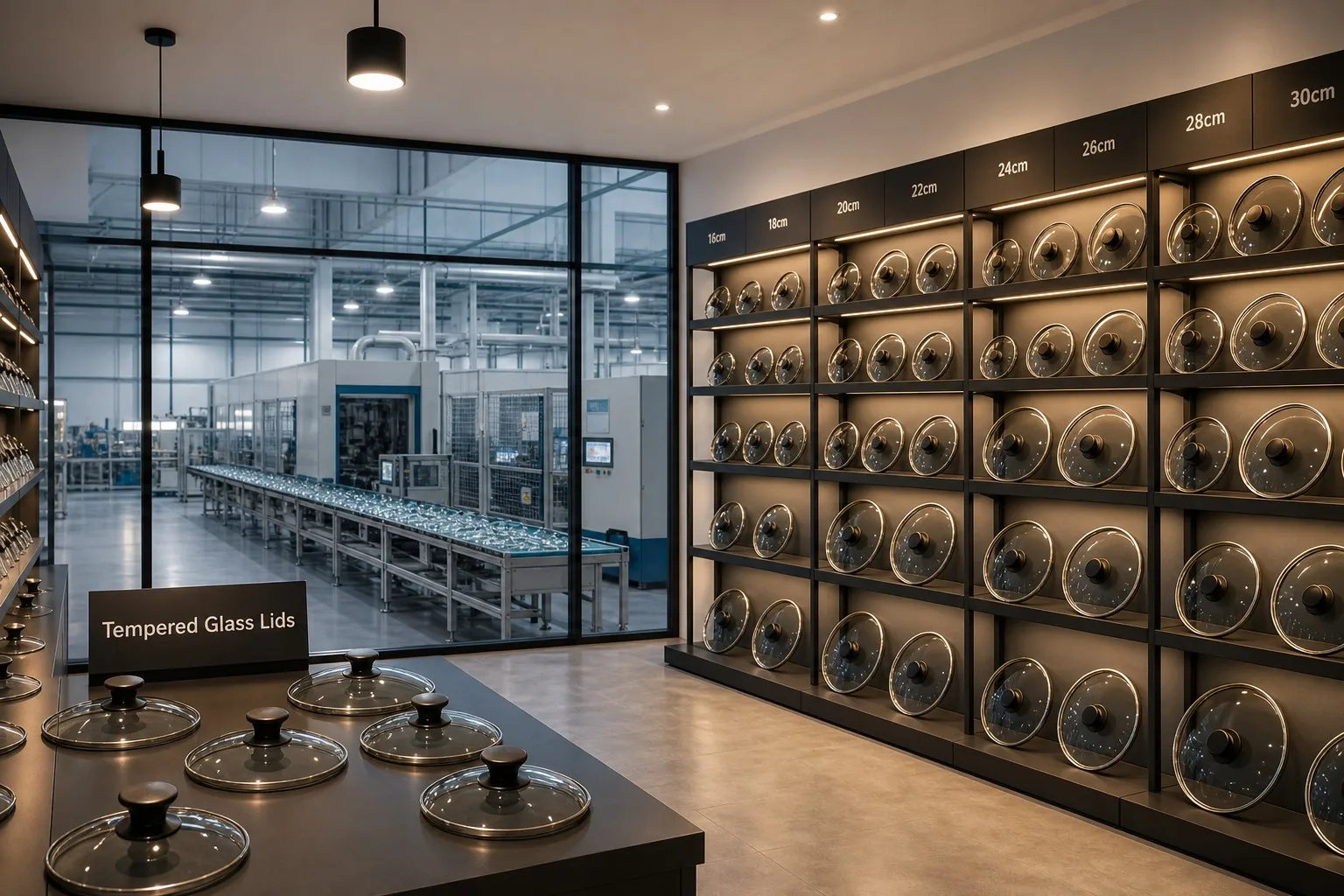
Cookware Glass Lid Manufacturer: Inside the 11-Step Production Process
Most procurement teams sourcing from a cookware glass lid manufacturer receive a finished product sample and a price sheet. Fewer see behind the production process that produces that sample — and understanding that process is one of the most reliable ways to assess whether a factory's quality claims are credible. A tempered glass cookware lid passes through eleven distinct production steps from raw material to export-ready product. Each step has its own quality control checkpoints, its own potential failure modes, and its own implications for lead time and unit cost. This guide walks through all eleven steps as they are executed at a Fenghua-based factory, with notes on what each step means for OEM buyers.
Steps 1–4: Raw Material Selection, Cutting, Edge Processing, and Hole Drilling
The production sequence begins well before any glass is shaped or heated. The first four steps establish the dimensional and material foundation on which all subsequent processing depends.
Step 1 — Raw float glass selection: Tempered glass lids start as flat sheets of float glass, typically sourced from domestic Chinese float glass producers. The specification that matters at this stage is glass composition (soda-lime silicate for standard cookware applications), nominal thickness (4 mm for most lids, 5 mm for pressure cooker applications), and visual quality grade. A pot lid factory China that does not maintain an incoming material inspection record for each glass batch cannot trace production failures back to the raw material — a significant gap in a documented quality system.
Step 2 — CNC cutting: Flat glass sheets are cut to the circular (or oval, or oblong) blank shape using CNC water-jet or diamond-wheel cutting equipment. Dimensional accuracy at this stage determines whether the finished lid will fit its target pan diameter within specification. Typical diameter tolerance for cut blanks is ±0.5 mm. Burrs and micro-chips on the cut edge are addressed in the next step.
Step 3 — Edge grinding and polishing: The cut glass blank has a raw edge that is both a safety hazard and a structural weak point. CNC edge-grinding machines process the perimeter in multiple passes — rough grinding to remove the cut edge irregularities, then fine grinding and polishing to produce a smooth chamfered or bevelled edge profile. Edge quality directly affects thermal shock resistance: micro-cracks on an unfinished edge are the most common initiation site for thermal fracture in service.
Step 4 — Knob hole drilling: The central hole for the knob fastener is drilled using a diamond-core drill bit under water cooling. Hole diameter, position accuracy, and the quality of the drilled hole edge are specified in the product drawing. A hole that is off-centre, oversized, or has chipped edges creates a stress concentration that can contribute to breakage during knob installation or in service. Drill bit condition and water flow rate are the two process variables most commonly associated with hole quality problems.
Steps 5–8: Tempering, Rim Assembly, Knob Installation, and Silicone Seal Fitting
The middle four steps transform a dimensionally correct but structurally ordinary glass blank into a functional product assembly. The glass cookware lid supplier process is most differentiated from competitors at this stage.
| Step | Process | Key Quality Variable | Failure Mode if Skipped/Poor |
|---|---|---|---|
| 5 | Tempering (toughening) | Furnace temperature profile, hold time, quench rate | Insufficient surface compressive stress; thermal shock failure |
| 6 | Stainless/aluminium rim crimping | Rim diameter, crimp gap, edge contact uniformity | Loose rim, corrosion at contact point, out-of-round fit |
| 7 | Knob installation | Thread engagement depth, torque specification | Knob loosening or detachment under use load |
| 8 | Silicone seal/gasket fitting | Shore hardness, profile dimensions, food-contact compliance | Poor pan seal, gasket deformation under heat |
Step 5 — Tempering (toughening): The edged and drilled glass blank is loaded into a continuous roller furnace, heated to above the glass softening point, then rapidly quenched with air jets. This creates a surface compressive stress layer and a central tensile zone — the structural condition that gives tempered glass its characteristic fracture pattern (small blunt fragments rather than sharp shards) and its thermal shock resistance. Furnace capacity, loading density, and maintenance of the heating and quench elements are the primary variables that differentiate factories with consistent tempering quality from those with variable output.
Step 6 — Rim assembly: The stainless steel or aluminium rim is formed to the glass diameter and mechanically crimped around the glass perimeter using a purpose-built press tool. The rim serves both functional roles (edge protection, pan-seating surface) and aesthetic roles (finish, appearance). Rim material grade, surface treatment (brushed, polished, or painted), and crimp consistency are specified in the product drawing.
Step 7 — Knob installation: The knob is fastened through the central hole using a bolt and retaining hardware on the underside of the glass. Installation torque is specified to ensure the knob is secure without over-stressing the drilled hole. Knob material (phenolic, stainless, bakelite, or silicone-grip) is an OEM specification choice that affects both aesthetics and heat resistance.
Step 8 — Silicone seal fitting: For lids with a perimeter silicone gasket or silicone-rim design, the gasket is fitted at this stage. Gasket shore hardness, dimensional profile, and food-contact material certification (the silicone formulation must be food-safe for the target market) are all specification items that should appear in the purchase order.
Steps 9–11: Quality Inspection, Marking/Printing, and Export Packaging
The final three steps ensure the finished assembly meets the agreed specification, carries the required product information, and reaches the importer in saleable condition. These steps are where the production process intersects most directly with regulatory compliance and retail readiness.
Step 9 — Final QC inspection: The assembled lid undergoes the five-test QC protocol described in the factory's quality plan: visual AQL inspection, thickness verification (if not already checked at Step 1), thermal shock sample testing, rim dimensional check, and knob torque/pull-out test. Inspection is performed on a sampled basis from each production lot, with results recorded against the lot number. Passed lots receive a QC release stamp on the batch record; failed lots are quarantined for root-cause investigation.
Step 10 — Logo printing and marking (where specified): For OEM orders with silk-screen or laser-engraved logos, the marking step follows QC approval of the assembled lid. Printing after assembly (rather than before tempering) ensures that the logo is applied to a dimensionally verified piece and is not subjected to the stress of the tempering furnace. Country of origin marking, material composition labels, and care symbols required by the import market are also applied at this stage.
Step 11 — Export packaging: Finished lids are packed according to the buyer's packaging specification or, where no spec is provided, the factory's standard export pack. Standard export packaging for glass lids involves individual protective wrapping (foam sleeve or paper sleeve), inner carton assembly with dividers to prevent contact between pieces, and master carton with corner protection. Carton gross weight, dimensions, and stacking strength are relevant to import freight cost and warehouse receiving efficiency. Buyers with specific retail packaging requirements (branded boxes, hang-tag windows, retail-ready units) should include the packaging specification in the purchase order at the brief stage.
Compliance and Quality Certification Across the 11 Steps
Each of the eleven steps connects to one or more compliance requirements for the major import markets:
- Raw glass and silicone materials: Food-contact compliance for the target market — for US market, raw materials used in food-contact applications should be compliant with FDA food contact regulations; for EU/German market, LFGB certification covers the finished product test. These certifications apply to materials, not just processes, so the factory must document which material batches were used in each production lot.
- Tempering quality: Thermal shock performance is the practical verification of tempering adequacy. No specific international standard mandates a single test method for cookware glass lids, but buyers sourcing for major retail chains typically specify a thermal shock test protocol in their product specification document.
- Factory social compliance: BSCI or Sedex SMETA audit coverage should extend across all eleven production steps, not just glass forming. Rim stamping, knob installation, and packaging are typically performed by different departments or sub-teams within the factory, and audit coverage of these areas is not always consistent.
- Stainless steel rim: 304 stainless (18/8 composition) is the standard specification for corrosion resistance in cookware applications. Verification by XRF testing of incoming rim material is the most reliable method for confirming compliance when this is a purchase order requirement.
Boyu Glass Factory Direct Advantage
Boyu Glass (glasslidfactory.com) has operated all eleven production steps in-house in Fenghua, Ningbo since 2001. Tempering, rim crimping, knob installation, QC inspection, and export packaging are performed on a single production campus, eliminating the sub-contracting gaps that create quality and traceability problems in fragmented supply chains. OEM buyers receive lot-level documentation covering all five QC checkpoints, material compliance certificates for glass and silicone, and a pre-shipment inspection invitation as standard. MOQ 1,000 pcs per SKU; lead time 45 days FOB Ningbo.
Frequently Asked Questions
Does the order of the 11 steps vary between factories, and does that matter?
The core sequence — cut, edge, drill, temper, assemble, inspect, mark, pack — is consistent across serious Fenghua producers because it reflects the physical constraints of the process: you cannot temper after rim assembly, and you should not mark before QC inspection. What varies is the degree of in-house integration versus sub-contracting of individual steps. A factory that sub-contracts rim stamping or packaging to a separate workshop loses direct traceability over those steps. Ask specifically which steps are performed in-house and which involve external suppliers or workshops.
How does the tempering step affect lead time, and can it be accelerated?
The tempering furnace is typically the capacity bottleneck in a glass lid factory. Furnace throughput is determined by the roller length, the heating zone capacity, and the loading cycle time. Rush orders that require bypassing the furnace queue are generally not possible without pushing another order back. A factory that offers to significantly shorten lead time below 30 days for a standard order is either scheduling your order ahead of existing commitments (creating a risk for those buyers) or running a shorter tempering cycle — the latter is a quality risk. Standard lead time of 40–45 days from confirmed PO is the realistic baseline for a properly sequenced production run.
At which step in the process should I send a third-party inspector for a pre-shipment inspection?
Pre-shipment inspection is most effective after Step 9 (final QC) and before Step 11 (export packaging carton sealing), so the inspector can examine the finished, assembled product in its finished condition before it is boxed. If packaging specification compliance is also within the inspection scope, the inspector should be present when a sample of cartons is packed and weighed. Arranging PSI access before the factory has completed Step 9 means inspecting product that the factory's own QC has not yet cleared — which creates ambiguity about whether any defects found were already known to the factory.
Related B2B Sourcing Guides
Continue reading on related sourcing topics for cookware brands and importers:
Conclusion
Three key takeaways for cookware brands evaluating a glass lid manufacturer's production capability:
- Integration depth is a quality signal. A factory that performs all eleven steps on a single campus — particularly tempering, rim assembly, and QC inspection — has direct control over the process variables at each step. Sub-contracting individual steps introduces traceability gaps that become problematic when a production issue requires root-cause analysis.
- Step 5 (tempering) is the irreversible quality-determining step. Every quality characteristic that matters in service — thermal shock resistance, fragment pattern on breakage, surface compressive stress — is set at the tempering furnace and cannot be corrected downstream. Furnace maintenance records, operator qualification, and batch tempering logs are the most informative documents for assessing a factory's capability at this step.
- Specify your requirements at each step, not just the finished product. A purchase order that specifies only the finished product dimensions and price leaves the factory free to make process decisions at each of the eleven steps without reference to the buyer's requirements. A Product Quality Specification document that covers raw material grade, tempering performance criteria, rim material specification, and packaging requirements eliminates the most common sources of production disputes.
Ready to source factory-direct? Request a free quote within 24 hours: aman098@126.com or visit glasslidfactory.com