

Narrow-Rim vs Wide-Rim Glass Lids: OEM Configuration Guide for Cookware Brands — 2026 Edition
For cookware brands configuring OEM glass lid orders, the choice between narrow rim glass lid manufacturer OEM configurations and wide-rim alternatives is more consequential than it first appears. Rim width — the distance from the outer edge of the glass to the outermost edge of the metal rim band — determines pan compatibility range, seal geometry, visual weight, and the structural mechanics of how the lid sits on and seals a pan. These are specification decisions that lock in product behaviour for the lifetime of a SKU, and they need to be resolved before tooling is confirmed, not after samples arrive. This guide covers the engineering rationale behind each configuration, the trade-offs relevant to different cookware applications, and the OEM ordering parameters a procurement team needs to specify clearly.
Rim Width Definitions and the G-Narrow / G-Wide Distinction
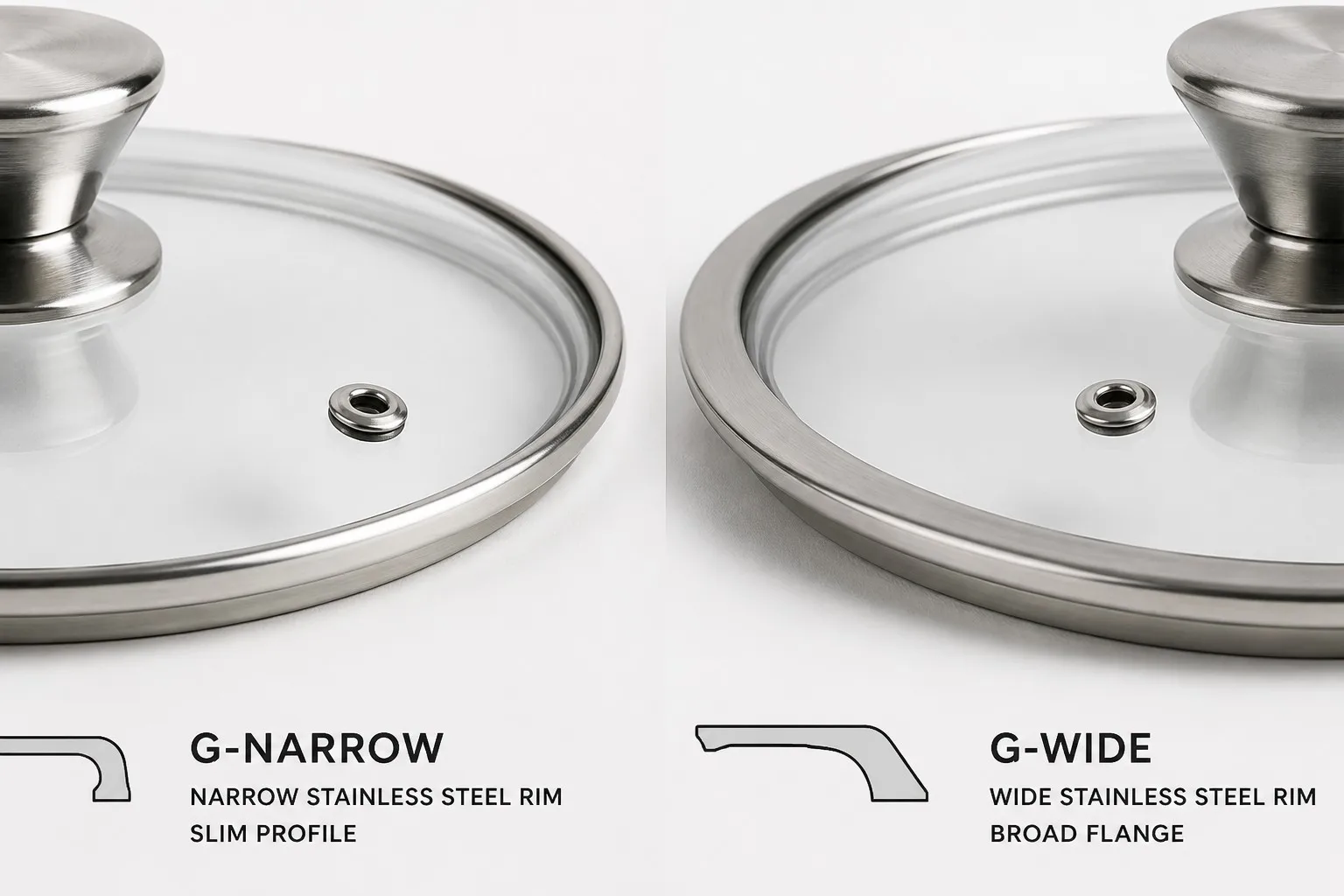
In Boyu Glass's G-Series product line, slim rim glass lid factory production covers the G-Narrow configuration, which uses a narrower rim band that sits closer to the glass perimeter. The G-Wide configuration uses a broader rim flange that extends further beyond the glass edge. The practical difference between these two configurations is not purely aesthetic — it governs several functional and compatibility parameters.
G-Narrow (narrow rim): The rim band is narrower in profile, designed for pans where the lid is expected to sit inside a recessed rim groove or where a minimal visual footprint is specified. The narrower flange means the lid's outer diameter is only marginally larger than the glass disc diameter. This makes G-Narrow lids particularly suitable for pans with a defined internal rim groove, for stacking-optimised cookware sets where lid-to-lid clearance is a concern, and for designs where a glass-forward visual effect is part of the product aesthetic.
G-Wide (wide rim): The rim band extends further beyond the glass edge, creating a broader metal flange that rests on the top edge of the pan wall. This wider contact area distributes the lid's seating load over a larger surface, which is mechanically advantageous for pans with thin or irregular top edges. Wide-rim configurations also provide a more positive visual stop when the lid is placed, which many buyers associate with a more substantial product feel. For pans without a defined internal groove, the wide rim provides the primary seating geometry.
Both configurations use the same tempered glass disc and the same knob assembly — the difference is exclusively in the rim band geometry. This means OEM buyers can often specify both configurations on the same glass size with no change to the glass tooling, only to the rim tooling.
Performance and Compatibility Comparison: 8 Decision Dimensions
Choosing between G-series glass lid wholesale narrow and wide configurations requires evaluating several dimensions simultaneously. The following table covers the eight most commonly cited decision factors for cookware brand procurement teams:
| Dimension | G-Narrow (Narrow Rim) | G-Wide (Wide Rim) |
|---|---|---|
| Pan compatibility | Best for pans with defined internal rim groove; tighter diameter match required | Wider tolerance; compatible with pans without groove; sits on top edge |
| Sealing geometry | Relies on glass disc and rim edge for seal; silicone gasket placement more critical | Broader flange contact area; more tolerant of minor pan-top irregularities |
| Visual weight | Lighter, minimal-profile appearance; glass-forward aesthetic | More substantial metal presence; perceived as heavier and more premium by some markets |
| Stacking efficiency | Better for nested lid sets; smaller outer diameter per glass size | Larger outer footprint; may require more shelf or storage clearance between sizes |
| Heat handle clearance | More clearance between rim and pan handle rivets on smaller diameters | Wide flange can contact handle rivets on small-diameter pans; verify in sample |
| Rim material options | 304 SS standard; aluminium available; plated options available | Same material options; wider flange makes surface finish more visible |
| OEM tooling cost | Standard — same tooling range as G-Series baseline | Standard — same tooling range as G-Series baseline |
| Typical application | Cookware sets with matched pans, stainless or hard-anodised lines | Universal lid sets, ceramic-coated pan lines, mid-market mass-market cookware |
One practical note on diameter specification: the nominal diameter stated in a G-Narrow or G-Wide order refers to the glass disc diameter. The finished outer diameter of the lid (including the rim) will differ between the two configurations even for the same glass size. Buyers specifying lids to fit existing pan tooling should request the factory's outer diameter specification sheet for both configurations before confirming the order diameter.
Compliance, Material Standards, and Quality Requirements
Both G-Narrow and G-Wide configurations are subject to the same compliance requirements, since the glass disc and knob assembly are identical and only the rim geometry differs. Key compliance considerations for OEM orders include:
- Stainless steel rim grade: 304 stainless (18/8 composition) is the standard specification for both configurations. For markets where corrosion resistance claims are part of the product marketing, XRF verification of incoming rim material is the most reliable confirmation method. Alternative rim materials (aluminium, carbon steel with plating) should be specified explicitly in the purchase order along with the required surface treatment standard.
- FDA / LFGB compliance: Applies to the silicone gasket material and any food-contact coatings on the rim. These are material certifications — the factory should be able to provide material compliance documentation for the specific silicone formulation used in each production run.
- Thermal shock testing: Both configurations pass the same thermal shock test protocol. The rim geometry does not affect thermal shock performance, which is determined by the glass tempering parameters. Buyers should request lot-level thermal shock test records as standard pre-shipment documentation.
- BSCI / Sedex audit coverage: Both rim configurations are produced in the same production department. BSCI audit scope should confirm that rim stamping, assembly, and QC inspection are all within the audited facility perimeter.
Boyu Glass Factory Direct Advantage
Boyu Glass (glasslidfactory.com) produces both G-Narrow and G-Wide configurations in Fenghua, Ningbo, with in-house rim stamping, glass-to-rim assembly, and QC inspection on a single campus. OEM buyers can order both configurations from the same glass size without separate tooling costs, using the same glass disc tooling with different rim tooling. Sample lead time is typically 7-10 days from confirmed specification; production lead time is 45 days FOB Ningbo. MOQ is 1,000 pieces per SKU per configuration. Material compliance documentation for 304 stainless rim and food-contact silicone is available as standard.
Frequently Asked Questions
Can I order a mixed set — some narrow-rim and some wide-rim — within the same purchase order?
Yes. Since the glass disc is the same for both configurations at a given diameter, a mixed order at the same glass size counts as two SKUs (two rim toolings), each subject to the per-SKU MOQ. If ordering multiple diameters with both configurations, each diameter-configuration combination is a separate SKU. The factory's production planning treats them as parallel production runs using the same glass blanks with different rim assembly lines, which means there is no lead-time penalty for mixing configurations within the same order.
Which configuration is better for universal lid sets that need to fit multiple pan diameters?
G-Wide is typically the preferred configuration for universal lid sets. The broader rim flange provides a larger seating surface that tolerates a wider range of pan-top geometries across different manufacturers. G-Narrow lids require a more precise diameter match to seat correctly, which limits their compatibility range. For a universal set intended to cover a 10-30 cm range, specifying G-Wide for each diameter gives the broadest compatibility envelope. If the universal set is sold alongside a matched pan range where lid-to-pan fit is guaranteed, G-Narrow may be viable depending on the pan's rim groove specification.
Does the rim configuration affect the lid's performance in a dishwasher?
The rim configuration itself does not significantly affect dishwasher performance, but the rim-to-glass junction quality does. On both G-Narrow and G-Wide lids, the crimp between the metal rim and the glass edge can trap moisture if the crimp is insufficiently tight or if the gap seal is inadequate. Over time, this can cause rust at the rim edge on lower-grade stainless or rust staining on aluminium rims without adequate surface treatment. Specifying 304 stainless and requesting a crimp tightness standard in the purchase order is the most reliable way to address this concern for both configurations.
Related B2B Sourcing Guides
Continue reading on related sourcing topics for cookware brands and importers:
Conclusion
Three key takeaways for cookware brand procurement teams choosing between narrow-rim and wide-rim glass lid configurations:
- Rim width is a compatibility specification, not just a visual preference. G-Narrow requires a more precise diameter match to the target pan; G-Wide provides a broader compatibility envelope. Confirm the pan-top geometry and whether a rim groove is present before specifying the configuration, not after samples are produced.
- Both configurations share the same glass tooling cost at a given diameter. Mixed orders (G-Narrow and G-Wide at the same diameter) are production-efficient and do not require separate glass tooling. The incremental cost of stocking both configurations is limited to the per-SKU MOQ, not to additional tooling investment.
- Document the outer diameter specification, not just the glass disc diameter. The finished outer diameter differs between G-Narrow and G-Wide at the same glass size. Purchase orders that specify only the glass disc diameter will produce lids with different outer dimensions depending on which rim is applied — a common source of fit disputes that is easily prevented by requesting the factory's rim-inclusive outer diameter specification before order confirmation.
Ready to source factory-direct? Request a free quote within 24 hours: aman098@126.com or visit glasslidfactory.com