

Custom Logo on Tempered Glass Lids: Silk-Screen vs Laser Engraving — 2026 OEM Factory Guide
Related B2B Sourcing Guides
Continue reading on related sourcing topics for cookware brands and importers:
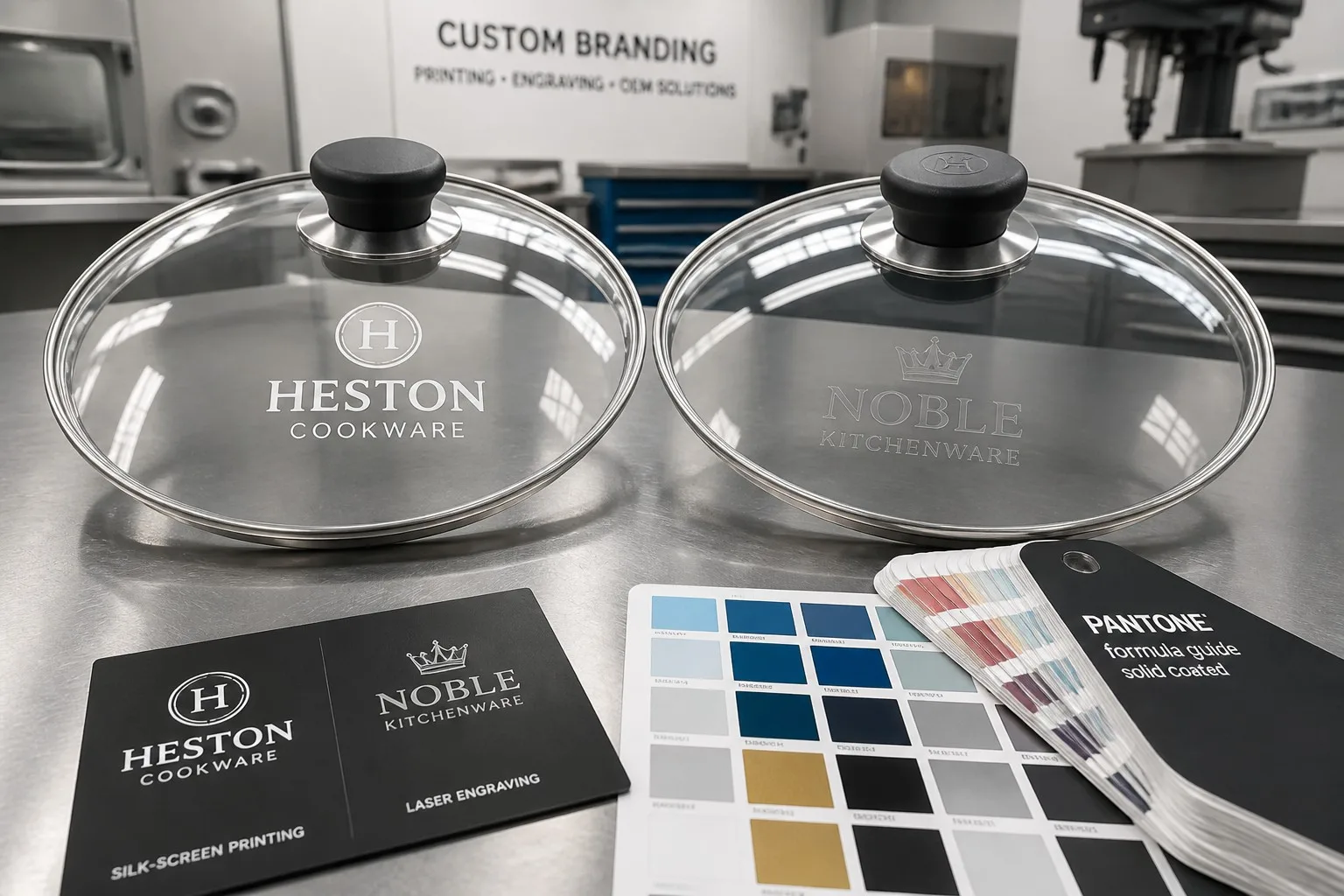
For cookware brands building a private-label programme, choosing how to apply a logo to a custom logo glass lid OEM factory order is a decision that affects product durability, visual quality, regulatory compliance of the ink or process, minimum order quantities, and per-unit cost across the product's full lifecycle. The two established methods are silk-screen (screen) printing and laser engraving. Both are widely available at Fenghua glass lid factories; neither is universally superior. The right choice depends on the brand's positioning, target market, order volume, and tolerance for process constraints. This guide covers what procurement teams need to know before specifying either method in an OEM brief.
1. Silk-Screen Printing: How It Works and Where It Performs Best
Silk-screen (serigraphy) printing on tempered glass lids uses a mesh stencil to deposit a specialist glass-ceramic ink onto the glass surface. The printed glass is then re-fired in a kiln at temperatures high enough to fuse the ink permanently into the surface — a process typically called firing or enamelling. The result is a colour-printed logo that is chemically bonded to the glass rather than sitting on top of it as a surface coating.
Key characteristics of silk screen glass lid logo application:
- Colour flexibility: The most significant advantage of silk-screen printing is colour range. Pantone-matched solid colours, multi-colour logos, and gradient-style designs are achievable. Factories typically quote per-colour setup fees, and complex designs with 4+ colours carry both higher tooling costs and longer setup lead times.
- Position precision: The silk-screen frame is registered to the glass shape during setup. Positional accuracy across a production run is typically within ±1–2 mm, which is acceptable for most brand mark applications but may be insufficient for fine typographic details smaller than approximately 3 mm in height.
- Durability: Fired glass-ceramic ink is highly resistant to mechanical abrasion and dishwasher cycling. The ink cannot be peeled, scratched with a fingernail, or removed by normal cleaning chemicals. This durability profile makes it appropriate for cookware lids positioned in the mid-to-premium retail segment.
- Food-contact compliance: The ink formulation is safety-critical. For US and EU market cookware, specify that only lead-free and cadmium-free glass-ceramic inks are used, and request the ink supplier's material safety data sheet. Reputable Fenghua factories use compliant ink formulations as a baseline, but this should be confirmed in writing.
2. Laser Engraving: Characteristics, Constraints, and Positioning Fit
Laser engraving on tempered glass uses a focused laser beam to ablate (remove) a thin layer of the glass surface, creating a frosted or etched appearance in the engraved area. No inks, coatings, or additional materials are applied — the logo is created by surface texture contrast rather than added pigment.
| Attribute | Silk-Screen Printing | Laser Engraving |
|---|---|---|
| Colour options | Full colour (Pantone match) | Single tone (frosted/clear contrast) |
| Setup tooling | Screen frame per colour (physical tooling) | Digital file only (no physical tooling) |
| Minimum order (logo setup) | Typically 500–1,000 pcs per design | No MOQ premium from setup; production MOQ applies |
| Design change speed | 5–8 days for new screen | Same day (digital update) |
| Durability | Very high (kiln-fused) | Permanent (structural glass modification) |
| Visual effect | Opaque colour fill, high contrast | Subtle frosted texture, premium tactile feel |
| Food contact materials | Ink compliance documentation required | No additional materials (glass only) |
| Unit cost premium | Moderate (ink + firing labour) | Moderate to low (no consumables) |
Key characteristics of laser engraving cookware lid application:
- No tooling cost: Because the laser is programmed digitally, design changes carry no physical retooling cost and no minimum quantity premium from the logo process itself. This makes laser engraving the preferred method for brands in early development that need to iterate on logo design between production runs.
- Premium visual positioning: The frosted, tactile finish of a laser-engraved logo reads as premium in the retail environment — particularly for cookware positioned at higher price points where a subtle, embossed-style mark differentiates the product from screen-printed alternatives.
- Design constraint — colour: Laser engraving cannot produce colour. The result is always a contrast between frosted glass and the transparent or coloured glass surface. Brands with multi-colour logos must either use silk-screen for those elements or accept a monochrome mark.
- Depth and detail: Fine serifs and very small text (below approximately 2 mm height) may lose definition depending on the laser parameter settings and the optical clarity of the glass. Request a laser sample on your specific glass type before committing to a production run.
3. Quality, Compliance, and Durability Standards
Both branding methods must be evaluated within the same quality framework as the underlying glass lid. Regardless of which method is specified, a compliant Fenghua OEM factory should provide:
- For silk-screen printing: Ink supplier material safety data sheet confirming lead-free and cadmium-free formulation. For EU market products, ink formulations should additionally comply with applicable food-contact materials regulations governing indirect contact coatings on cookware. Request that the factory specifies the ink brand and formulation reference in the production order documentation.
- For laser engraving: No additional material compliance documentation is required beyond the glass substrate and rim certifications, since laser engraving introduces no new materials. This simplifies the documentation stack for brands in markets with strict import compliance requirements.
- Both methods: Logo durability should be tested alongside standard thermal shock cycling (200°C to 20°C) and dishwasher simulation. A qualified factory will test logo adhesion or surface integrity as part of the pre-production sample approval process. Request evidence of this testing in the sample approval documentation.
- BSCI/Sedex social compliance: Logo application is a factory-floor process. Ensure the factory's social compliance audit (BSCI or Sedex SMETA) covers the printing/engraving department, not only the glass production area.
4. Boyu Glass Factory Direct Advantage
Boyu Glass (glasslidfactory.com) supports both silk-screen printing (Pantone-matched, single or multi-colour) and laser engraving as standard OEM services on all C-Series, G-Narrow, G-Wide, and Silicone-Rim lid ranges. Silk-screen setup requires 5–8 days for new screen fabrication; laser engraving begins from digital file receipt. All ink formulations used are lead-free and cadmium-free; material data sheets are provided on request. Logo durability is validated as part of our pre-production sample approval process. MOQ is 1,000 pieces per SKU; standard production lead time is 45 days from confirmed PO and approved logo artwork.
Frequently Asked Questions
Can both silk-screen printing and laser engraving be applied to the same lid?
Yes, combining both methods on a single lid is technically feasible — for example, a laser-engraved brand mark on the top surface and a silk-screen printed size or care symbol on the underside. The practical consideration is that each method requires its own production step and setup, which adds to unit cost and production time. Confirm the combined workflow lead time with the factory at the brief stage before committing to a combined specification.
How many colours can be applied with silk-screen printing, and what is the practical limit?
Factories producing glass lids with silk-screen printing typically work comfortably with 1–3 colours. Each additional colour requires a separate screen, a separate printing pass, and a corresponding alignment registration step. Designs with 4 or more colours carry increasing registration complexity and per-unit cost. For complex multi-colour logos, request a sample production run of 50–100 pieces before approving for full production, to verify colour registration accuracy and ink layering consistency.
Is laser engraving suitable for logos that include fine gradients or photographic-style imagery?
Standard laser engraving on glass produces a binary result — engraved or not engraved — without the tonal variation needed for photographic imagery or smooth gradients. Some advanced laser systems support a technique called laser halftoning, which creates the appearance of gradients through variable dot density, but this capability is not universal across Fenghua factories. If gradient or photo-style imagery is a requirement, silk-screen printing with a specialist halftone screen, or a combination of methods, should be discussed with the factory during the brief stage.
Related B2B Sourcing Guides
Continue reading on related sourcing topics for cookware brands and importers:
Conclusion
Three key takeaways for cookware brands specifying custom logo application on tempered glass lids:
- Choose the method based on colour requirement first. If the brand mark requires colour, silk-screen printing is the only established option for glass lids. If the logo works in a single frosted tone, laser engraving offers simpler documentation, no physical tooling cost, and a premium tactile finish.
- Request a physical sample before committing to full production. Both methods have design constraints (registration tolerance for silk-screen, minimum detail size for laser engraving) that only become visible in practice. A sample of 20–50 pieces against the approved artwork eliminates the most common sources of first-production rejection.
- Confirm ink compliance documentation upfront for silk-screen orders. The ink formulation is a food-contact material component. Requesting the material data sheet at the RFQ stage — not at the QC stage — ensures the factory's ink sourcing aligns with your import market requirements before production begins.
Ready to source factory-direct? Request a free quote within 24 hours: aman098@126.com or visit glasslidfactory.com