

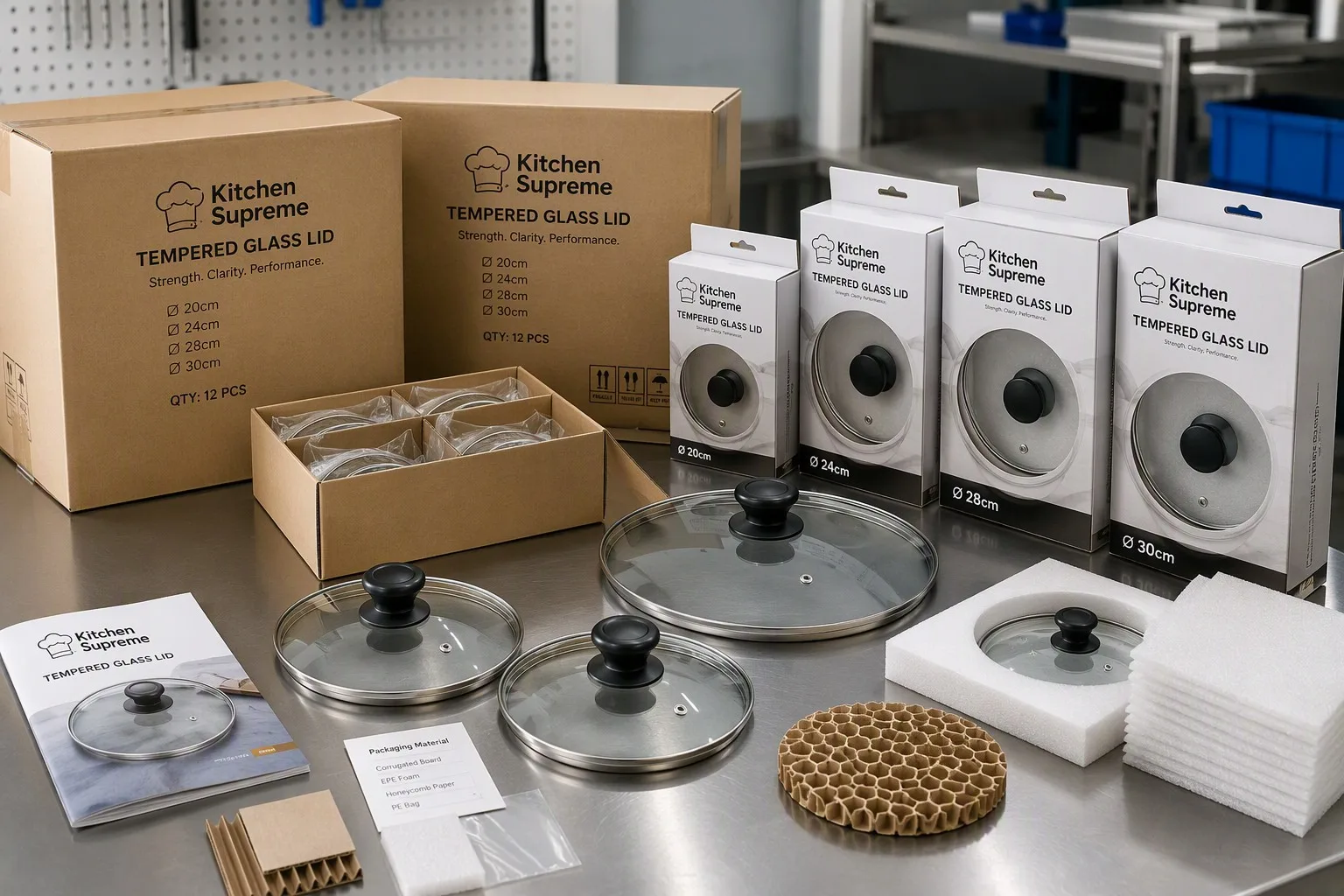
OEM Packaging for Tempered Glass Lids: From Export Cartons to Retail-Ready Packs — 2026 Specification Guide
Custom cookware lid packaging OEM from China spans a wide range of formats — from a bare bulk shipment with foam interleaving to a fully branded retail box with an FSC-certified paperboard shell, a printed insert, and a scannable EAN barcode. The format you choose determines transit damage rates, retail shelf visibility, unboxing experience, and the compliance labelling requirements you need the factory to meet. This guide covers the four main packaging tiers available from Chinese glass lid factories, the structural and print specification inputs required for each, and the decision criteria that determine which format is appropriate for your route to market.
Packaging Tiers: What a Chinese Factory Can Produce
When sourcing glass lid retail packaging from a factory, the starting point is defining the packaging tier — the level of protection and presentation the product needs. Each tier has a different cost structure, MOQ implication, and lead time component. The four main tiers are:
- Tier 1 — Bulk loose with interleaving: Lids are packed in groups within a master export carton, separated by PE foam sheets or corrugated dividers. No individual wrap. Used for replacement parts supply, restaurant supply chains, and buyers who repack under their own brand after import. The lowest cost packaging format; requires a robust master carton to compensate for the absence of individual protection.
- Tier 2 — Individual PE wrap or polybag: Each lid is wrapped in polyethylene foam or a sealed polybag before being placed in the master carton. Protects the glass surface and rim finish from transit abrasion. Standard for cookware set components and replacement lid programmes where the individual unit is handled in a distribution centre before reaching the end user.
- Tier 3 — Retail paperboard box: Each lid is packed in a printed paperboard box with a structural insert (die-cut foam or corrugated shell) to hold the lid in position. The box carries the brand's retail graphics, product information, barcode, and compliance labelling. Used for retail channel supply — supermarkets, kitchen stores, online retail (where the box is the visible product image in the listing).
- Tier 4 — PDQ display pack or hanging retail card: Designed for point-of-sale display. PDQ (product display quantity) packs are structured display-ready cartons that double as shelf units. Hanging cards are used for pegboard display in hardware and kitchen accessory retail. Both require additional structural engineering and print specification beyond a standard retail box.
Specification Inputs by Packaging Tier
To request a custom cookware lid packaging OEM quote from a factory, provide the following specification inputs for each tier. Missing inputs delay the sample process because the factory must assume dimensions and materials, which rarely match the buyer's intent.
| Specification input | Tier 1 (bulk) | Tier 2 (individual wrap) | Tier 3 (retail box) | Tier 4 (PDQ/hanging) |
|---|---|---|---|---|
| Lid dimensions | Required | Required | Required | Required |
| Units per master carton | Required | Required | Required | Required |
| Interleave material | Specify (PE foam / corrugated) | Specify wrap type | Specify insert type | Specify insert type |
| Retail box dimensions | Not applicable | Not applicable | Required (W×H×D mm) | Required (W×H×D mm) |
| Paperboard specification | Not applicable | Not applicable | Required (gsm + coating) | Required (gsm + coating) |
| Print artwork | Master carton print (optional) | Not applicable | Required (vector, CMYK + Pantone) | Required (vector, CMYK + Pantone) |
| Barcode / EAN | Master carton barcode | Optional | Required (EAN-13 or UPC-A) | Required |
| Compliance text | Country of origin | Country of origin | Full compliance labelling for destination market | Full compliance labelling |
The export carton cookware lid specification — master carton burst strength, stacking load, and moisture resistance — is often overlooked by buyers focused on the retail box. A retail box packed inside a master carton that fails in transit results in the same customer complaint as a broken lid. Specify master carton board weight (typically 5-ply B/C flute corrugated or equivalent ECT rating) and stacking height requirement for container loading.
Compliance and Quality Requirements for OEM Packaging
Packaging for glass lids sold in major import markets carries compliance requirements that extend beyond the product itself. At the OEM packaging specification stage, confirm the following:
- Country of origin marking: "Made in China" or equivalent must appear on the individual retail unit and the master carton in a legible, permanent format. This is a customs requirement for most destination markets, not an optional brand element.
- Material safety for food-contact adjacent packaging: Paperboard used in direct-contact packaging (an inner tray or insert that touches the glass surface) should be produced from food-safe materials or separated from the glass surface by a food-safe barrier. Request confirmation from the factory on the paperboard specification used for direct-contact elements.
- FSC certification (EU/UK retail requirement): Major European and UK grocery retailers increasingly require FSC-certified paperboard for product packaging. If your retail customer requires FSC, confirm at the sample stage that the factory's paperboard supplier holds current FSC Chain of Custody certification, not just that the paperboard is described as "FSC-available."
- Drop and vibration test records: For Tier 3 and Tier 4 packaging, request evidence that the packaging configuration has been tested to ISTA 1A or equivalent for the transit mode and stacking weight applicable to your supply chain. A packaging design that has not been tested may perform poorly in courier or palletised freight conditions even if it looks structurally adequate.
Boyu Glass Factory Direct Advantage
Boyu Glass (glasslidfactory.com) supports all four packaging tiers for its C-Series, G-Narrow, G-Wide, and Silicone-Rim product lines. Retail box and PDQ pack dielines are produced for buyer approval before tooling commitment. Print artwork is reviewed against the production file before plating. Country of origin and compliance text placement are confirmed at the proof stage. FSC-certified paperboard is available on request. Packaging samples are shipped with the pre-production product sample. MOQ: 1,000 pcs per SKU. Lead time: 45 days FOB Ningbo including standard Tier 2 or Tier 3 packaging.
Frequently Asked Questions
Does OEM packaging increase the minimum order quantity or lead time?
Standard Tier 1 (bulk) and Tier 2 (individual wrap) packaging are typically included in the standard product MOQ and lead time. Tier 3 retail boxes with custom print require a packaging-specific MOQ — typically 1,000 to 3,000 units for the first run to amortise dieline tooling and plate costs — and add 5 to 10 working days to the lead time for artwork approval and packaging sample production. Tier 4 PDQ or display packs require a structural engineering step and a longer approval cycle; plan for 2 to 3 additional weeks for the first production run.
Can the factory print the retail box in multiple languages for different export markets?
Yes, most Chinese glass lid factories offering retail packaging can print multi-language artwork if the buyer provides the translated text in the correct format. The print dieline and colour setup remain the same; only the text content changes. Note that language variants require separate print files and are typically produced in separate print runs unless the volume justifies a multi-language master. Confirm with the factory whether multi-language artwork is supported within a single order or requires separate SKUs for production planning purposes.
What file format should I provide for the retail box print artwork?
Provide vector artwork in AI, EPS, or PDF format with all fonts converted to outlines. CMYK colour mode is required for offset and digital printing; if specific Pantone spot colours are required (for brand colour accuracy), provide the Pantone reference numbers and confirm with the factory whether spot colour printing is available for your volume. Raster files (JPEG, PNG) are not suitable for print artwork submission — they do not scale without quality loss and cannot be separated for colour printing. Supply a print-ready PDF with bleed marks and colour profile embedded for verification at the proof stage.
Related B2B Sourcing Guides
Continue reading on related sourcing topics for cookware brands and importers:
Conclusion
- Define the packaging tier before requesting a quote. Bulk loose, individual wrap, retail box, and PDQ display are structurally and cost-differently distinct formats. Requesting a quote without specifying the tier produces an incomparable range of responses that delay the sourcing decision. Define the tier and provide the specification inputs before the first factory enquiry.
- The master carton is as important as the retail box. Transit damage on glass lids is most commonly caused by master carton failure, not individual unit protection failure. Specify master carton board weight, stacking load, and moisture resistance alongside the retail box specification — especially for sea freight shipments where the carton is at risk for 3 to 5 weeks before customs clearance.
- Compliance requirements for packaging differ by market and retail channel. Country of origin marking, FSC certification, and compliance labelling requirements vary by destination market and customer. Confirm these requirements before the packaging sample is produced — retroactively adding compliance text to printed stock is costly and often impossible without reprinting the packaging run.
Ready to source factory-direct? Request a free quote within 24 hours: aman098@126.com or visit glasslidfactory.com