

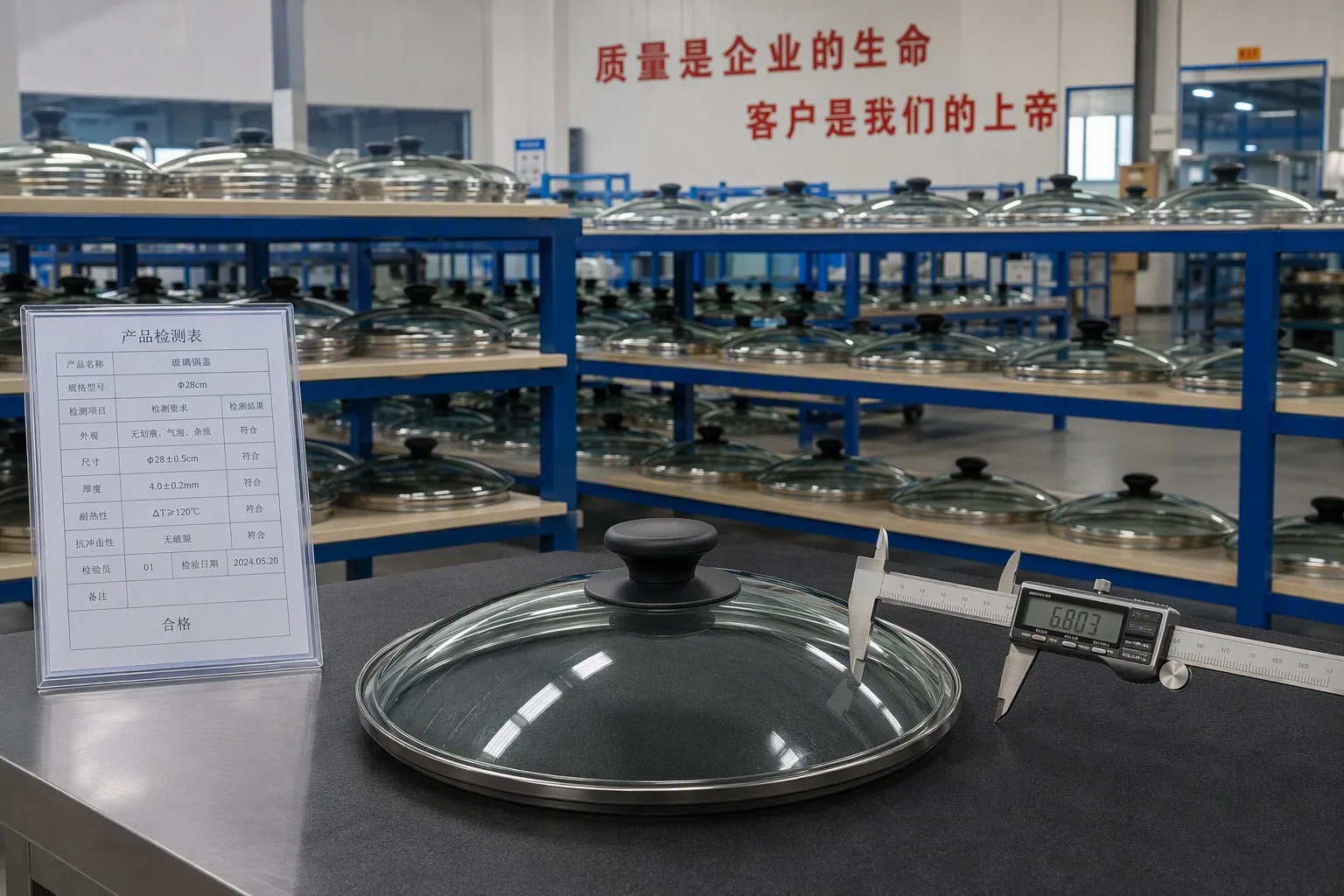
Ordering Samples from a Glass Lid Factory: What to Inspect Before Mass Production — 2026 Guide
A glass lid factory sample order in China serves a specific purpose: it is a structured evaluation of whether the factory can execute your specification before you commit production capital. Buyers who skip or rush the sample inspection phase frequently discover specification drift at mass production — when correction cost and lead time are an order of magnitude higher. This guide identifies the seven checkpoints that matter most when evaluating a tempered glass lid sample, explains what documentation to collect at each step, and describes how to structure feedback so the second sample resolves the issues identified in the first.
Pre-Production Sample: How to Request One and What to Specify
A pre-production sample glass lid is distinct from a catalogue sample. A catalogue sample demonstrates general factory quality using a standard product. A pre-production sample is manufactured to your specific drawing or specification sheet — validating that the factory can produce to your tolerance, rim configuration, glass thickness, print placement, and packaging requirements before you place the production order.
Your sample brief must include: glass diameter and thickness with tolerance; rim type (C-Series, G-Narrow, or G-Wide) and silicone gasket specification if applicable; knob material, height, and mounting configuration; surface print or engraving artwork with method and colour reference; and inner/outer packaging configuration. Omitting any field forces the factory to assume — and assumptions rarely match intent. Send the brief in writing and request written acknowledgement of the factory's interpretation of each specification field before sample production begins.
Seven Checkpoints for Glass Lid Sample Inspection
Inspect every sample against the following seven checkpoints. Passing six of seven is not a production approval — each checkpoint is a separate gate.
| Checkpoint | What to check | Pass condition | Action on fail |
|---|---|---|---|
| 1. Dimensional accuracy | Caliper — diameter, glass thickness, knob height | Within stated tolerance (typically ±0.5 mm diameter, ±0.2 mm thickness) | Reject if OOT; revise brief if tolerance was not stated |
| 2. Glass clarity | Hold to light — check for bubbles, seeds, streaks | No visible inclusions; surface free of chips or scratches | Reject structural inclusions; note cosmetic marks for AQL |
| 3. Rim assembly | Rim seating, crimp uniformity, exposed edge check | Rim flush, crimp uniform, no exposed glass edge | Reject if glass edge exposed (safety); revise if alignment off |
| 4. Silicone gasket | Gasket seating, profile consistency, colour, odour | No gaps/folds; colour matches spec; no chemical odour | Reject wrong profile or strong odour; revise colour |
| 5. Thermal shock | Hot-to-cold water cycle; inspect for crack initiation | No crack, chip, or delamination after one cycle | Reject; flag to factory for tempering parameter review |
| 6. Print / engraving | Position, colour (vs Pantone ref), line quality | Position ±2 mm; colour consistent; no bleed or missing elements | Reject missing logo; revise position or colour variance |
| 7. Packaging | Inner protection, carton print, barcode scan | Lid held securely; carton print matches spec; barcode scannable | Revise if protection inadequate; reject unreadable barcode |
A cookware lid sample inspection that omits packaging is the most common oversight — it leads to transit damage claims on the first production shipment. All seven checkpoints are required for a valid production approval.
Compliance Documentation to Request at Sample Stage
Request compliance documentation alongside the sample — not after production has been placed. At minimum, collect: the factory's tempering parameter confirmation for this product; FDA 21 CFR 177.2600 or LFGB §30/31 test report covering the specific silicone formulation and colour used (if silicone-rim); current BSCI or Sedex audit certificate if your procurement policy requires social compliance; and a sample of the factory's thermal shock test records if batch QC is claimed. A factory that cannot produce current compliance documentation at the sample stage will not produce it faster under production schedule pressure. Treat inability to provide documentation at this stage as a procurement risk to be resolved before the production order is issued.
Boyu Glass Factory Direct Advantage
Boyu Glass (glasslidfactory.com) ships pre-production samples with a dimensional check sheet confirming the measurements taken at the factory before dispatch. FDA, LFGB, and BSCI documentation is available at the sample stage. Standard sample lead time is 7–10 working days from brief confirmation. MOQ for mass production: 1,000 pcs. Lead time: 45 days FOB Ningbo. Factory location: Fenghua, Ningbo, Zhejiang, China. Established 2001.
Frequently Asked Questions
How many sample units should I order from a new glass lid factory?
Order a minimum of three: one for dimensional and visual inspection, one for the thermal shock test (destructive), and one retained as the approved golden sample for future production comparison. If your product has a print or engraving, order at least five — print quality can vary within a small sample run and a single unit may not be representative. Store the golden sample in a labelled sealed bag with date, factory name, and specification reference. It is the benchmark for production AQL inspection.
What should I do if the sample fails one checkpoint but passes the others?
Document the failure with photographs and precise measurements and send written feedback to the factory within five working days. State exactly what was wrong, what the correct specification is, and what documentation you require in the second sample to confirm the correction. Do not issue a mass production approval until a corrected second sample has passed all seven checkpoints. A partial pass is the basis for a targeted second sample request — not a production green light.
Can a catalogue sample substitute for a pre-production sample?
Only if your order specification is identical to the standard catalogue product — same diameter, glass thickness, rim, knob, no custom print, and no packaging customisation. Most OEM orders include at least one custom element, which the catalogue sample cannot validate. Skipping the pre-production sample stage transfers all specification-error cost to the production run, where correction is substantially more expensive and time-consuming than at the sample stage.
Related B2B Sourcing Guides
Continue reading on related sourcing topics for cookware brands and importers:
Conclusion
- Specify before you sample. A vague brief produces samples that require multiple rounds of revision. Write the specification, confirm the factory's interpretation in writing, then order the sample.
- All seven checkpoints are required for approval. Partial passes are not production approvals — they are targeted second-sample requests. Packaging is the most commonly skipped checkpoint and the most commonly regretted.
- Collect compliance documentation at the sample stage. FDA, LFGB, and BSCI documentation that is unavailable at sample stage will not become available faster under production schedule pressure. Resolve documentation gaps before the production order is placed.
Ready to source factory-direct? Request a free quote within 24 hours: aman098@126.com or visit glasslidfactory.com