

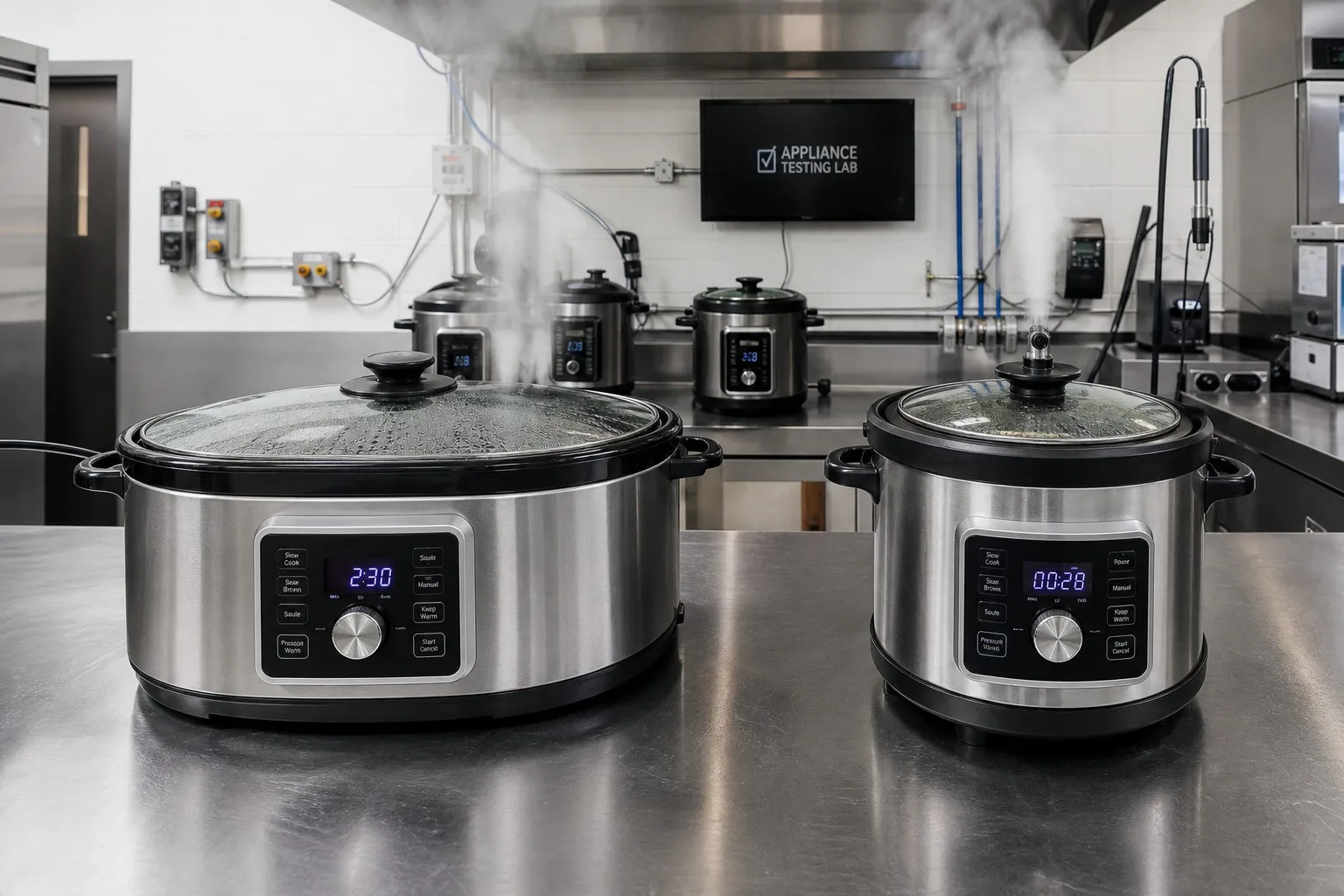
Oval Tempered Glass Lid Supplier: 2026 Updated OEM Guide for Electric Pressure Cooker and Multi-Cooker Brands
Sourcing from an oval glass lid supplier China OEM requires a different specification framework than buying standard round cookware lids. Oval lids for electric pressure cookers, multi-cookers, and rice cookers involve non-circular glass cutting, matched sealing strip geometry, lid-to-body gap tolerances measurable in tenths of a millimetre, and thermal compliance requirements that differ from conventional stovetop lid applications. This 2026 updated guide covers the technical specifications, manufacturer qualification criteria, and lead time realities for appliance brands sourcing oval tempered glass lids from China.
1. Oval Lid Geometry: Why Standard Round-Lid Tooling Cannot Be Adapted
The most common mistake appliance brands make when approaching an oval tempered glass lid factory is assuming that oval lids are a simple shape modification of round production. In practice, oval glass cutting requires entirely separate CNC cutting programmes, grinding templates, and — critically — bespoke tempering moulds that support the non-circular profile through the 200°C–20°C thermal cycle without introducing asymmetric residual stress.
Key geometry parameters that must be specified in the OEM brief:
- Major axis (A) and minor axis (B): Oval lids are typically specified as A×B in millimetres (e.g., 280×230 mm for a 5-litre cooker). The A:B ratio affects the stress distribution during tempering — ratios above 1.4:1 require modified tempering mould geometry to prevent corner stress concentration.
- Corner radius (R): The transition from straight edge to curved end. Minimum R is typically 25 mm for 4 mm glass; tighter radii require slower grinding and longer tempering cycles to avoid edge micro-cracking.
- Glass thickness: Standard oval appliance lids use 4 mm or 5 mm soda-lime glass. Pressure cooker applications where the lid must withstand positive pressure cycles often specify 5 mm with a reinforced edge profile.
- Dome height: Oval lids for electric cookers typically use a shallower dome (height/minor axis ratio 1:8 to 1:10) than round stovetop lids, to maintain clearance for internal cooking chambers.
Each unique A×B combination requires dedicated tooling. Lead time for new oval mould fabrication is 10–18 calendar days, longer than round lids (7–12 days) due to the more complex mould profile.
2. Sealing Strip Specifications: The Component That Determines Appliance Safety
For the electric cooker lid manufacturer category, the sealing strip (gasket) that runs around the perimeter of the oval glass lid is the most safety-critical component — and the one most frequently under-specified in OEM briefs. In electric pressure cooker applications, this strip must maintain an airtight seal at working pressures up to 80 kPa above ambient for extended cooking cycles.
| Sealing Strip Material | Temp Range | Compliance | Pressure Rating | Typical Use |
|---|---|---|---|---|
| Food-grade silicone (VMQ) | -60°C to +230°C | FDA 21 CFR 177.2600, LFGB §64 | Up to 80 kPa | Electric pressure cookers, steam cookers |
| EPDM rubber | -40°C to +150°C | REACH SVHC-free | Up to 50 kPa | Multi-cookers, rice cookers (non-pressure) |
| NBR (nitrile rubber) | -30°C to +120°C | REACH, but avoid EU food-contact | Up to 40 kPa | Non-food-contact industrial applications only |
For EU and US market appliances, food-grade silicone is the only material that satisfies both FDA 21 CFR 177.2600 food-contact compliance and LFGB §64 migration testing requirements. EPDM is acceptable for non-pressurised multi-cooker applications but should not be used in pressure cooker lids destined for EU retail without specific third-party migration testing.
3. Compliance and Quality Standards for Appliance Lid Applications
Oval glass lids for electric appliances must meet a more complex compliance stack than standard stovetop cookware lids, because they are regulated both as cookware components and as electrical appliance parts in most target markets:
- EN 60335-2-9 (EU) / UL 197 (US): Household appliance safety standards. The glass lid is tested as part of the appliance system — thermal shock, mechanical impact, and pressure cycle testing are conducted on the assembled unit, not on the lid alone. Ensure your glass lid supplier provides components that have been tested in assembly with representative appliance bodies.
- EN 12983-1 Thermal Shock: Even for appliance applications, glass must pass thermal shock cycling (200°C to 20°C, minimum 5 cycles). For 5 mm glass, the minimum tempering cycle at Boyu Glass is 4.5–5.5 minutes to achieve the required surface compressive stress.
- FDA 21 CFR 177.2410 (glass) + 177.2600 (silicone): Required for US market appliances. The glass substrate and silicone sealing strip each require separate food-contact compliance documentation.
- GPSR (EU General Product Safety Regulation, effective 2024): Requires traceability documentation for each production batch. Oval lid suppliers should provide lot-level production records linking each shipment to its tempering cycle parameters, raw glass batch, and QC inspection records.
4. Boyu Glass Factory Direct Advantage for Appliance Brands
Boyu Glass (glasslidfactory.com) has manufactured oval tempered glass lids for electric cooker OEM programmes since 2001 in Fenghua, Ningbo. Our CNC glass cutting line handles oval formats up to 400×320 mm; our tempering furnace supports non-standard profiles with custom mould fabrication in 12–18 days. We supply FDA and LFGB test reports for glass substrates, coordinate silicone sealing strip testing with Intertek Ningbo, and provide per-lot GPSR traceability documentation. MOQ is 1,000 pieces per SKU; standard production lead time is 45 days from confirmed PO and approved engineering drawings.
Frequently Asked Questions
What is the minimum order quantity for a custom oval lid size not in your standard range?
For custom oval sizes requiring new mould fabrication (any A×B combination not in our 12 standard stock sizes), MOQ is 1,000 pieces per size. Mould tooling costs are amortised across the first production run. Repeat orders of the same custom size have no MOQ premium — standard 1,000-piece MOQ applies.
How long does it take to develop a new oval lid from engineering drawing to first sample?
From receipt of approved engineering drawing (including A×B dimensions, corner radius, glass thickness, dome height, and sealing strip specification): mould fabrication 12–18 days, first glass samples 5–7 days, sealing strip sampling 7–10 days (if custom profile). Total: 25–35 calendar days to first assembly sample. Mass production begins after buyer approval of samples.
Can oval glass lids for pressure cookers be shipped by air freight?
Yes. Oval lids are individually wrapped in foam-in-place packaging and crated in wooden export boxes rated for air freight handling. We have shipped to appliance brand development teams in Germany, Japan, and Australia via air freight for sample approval. Unit weight for a 280×230×5 mm oval lid assembly (with sealing strip and packaging) is approximately 820g. Air freight suitability must be confirmed with your freight forwarder for quantities above 50 pieces due to glass fragility insurance requirements.
Related B2B Sourcing Guides
Continue reading on related sourcing topics for cookware and appliance brands:
Conclusion
Three key takeaways for appliance brands sourcing oval tempered glass lids from China:
- Specify A×B dimensions and corner radius precisely: Oval lid tooling is geometry-specific. A drawing with full dimensional tolerances (±0.5 mm on A and B, corner radius ±2 mm) is the minimum required to begin mould fabrication. Verbal descriptions or rough sketches result in prototype rejection cycles that add 3–6 weeks to development timelines.
- Specify sealing strip material and pressure rating together: The lid glass and sealing strip form a functional unit. Specifying one without the other creates assembly risk. For EU market pressure cooker applications, food-grade silicone + FDA/LFGB documentation is non-negotiable.
- Require GPSR lot-level traceability from day one: EU GPSR enforcement has been active since December 2024. Appliance brands importing glass lids into the EU need lot-level production records to satisfy distributor and retailer compliance requirements. Build this into your supplier qualification checklist before placing the first order.
Ready to source factory-direct? Request a free quote within 24 hours: aman098@126.com or visit glasslidfactory.com