

Stainless Steel Rim Tempered Glass Lids: 2026 Updated OEM Specifications and Factory Selection Guide
For cookware brands sourcing from China, finding a qualified stainless steel rim glass lid manufacturer China requires more than comparing FOB prices. The stainless rim is the component that determines how a lid seals on a pan, whether it passes EN 12983-1 thermal cycling tests, and how it performs after 500+ dishwasher cycles. This guide covers the key OEM specification decisions, 2026-updated material standards, and the factory qualification criteria that differentiate a production-ready supplier from one that looks capable on paper.
1. 304 vs 430 Stainless Rim: The Material Decision That Affects Every Market
The first OEM specification decision for any 304 stainless glass lid OEM programme is steel grade. The two grades found in Fenghua production are 304 (18/8 chromium-nickel austenitic steel) and 430 (ferritic, chromium-only). The performance and regulatory implications differ materially:
| Property | 304 Stainless (18/8) | 430 Stainless (Ferritic) |
|---|---|---|
| Nickel content | 8–10.5% | 0% |
| Corrosion resistance | High (salt spray 500h+) | Moderate (200–300h) |
| LFGB §31 nickel migration | Must test; typically passes | Not applicable (no nickel) |
| Cost premium vs 430 | +18–25% | Baseline |
| Recommended market | US, EU (premium positioning) | Emerging markets, value tier |
| Magnet test result | Weakly magnetic or none | Strongly magnetic |
For US and EU retail programmes requiring LFGB and FDA food-contact declarations, 304 is the standard specification. Buyers targeting value-market distribution in Southeast Asia or Latin America sometimes specify 430 to reduce per-unit cost by $0.12–0.28 depending on diameter.
2. C-Series vs G-Series Rim Architecture: Configuration Specifications
Boyu Glass produces stainless rim lids across two primary architectures, each with distinct OEM configuration parameters relevant for C-series glass lid wholesale and G-series programmes:
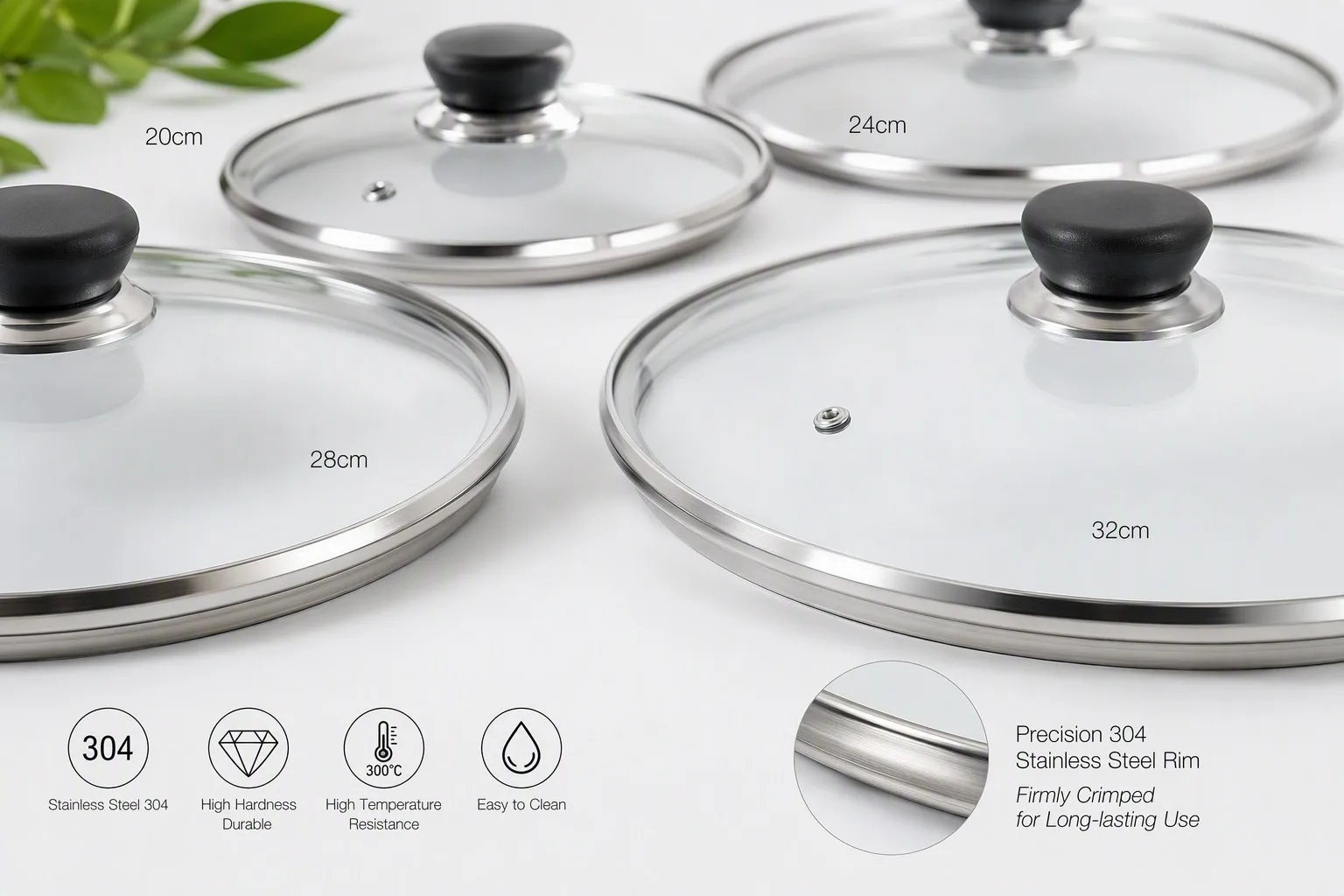
C-Series (Round, Crimped Stainless Rim): The C-Series uses a single-piece stamped stainless rim, cold-crimped over the glass perimeter. Standard rim width is 8–12 mm; rim thickness is 0.6–0.8 mm (304) or 0.5–0.7 mm (430). Available diameters: 18 cm, 20 cm, 22 cm, 24 cm, 26 cm, 28 cm, 30 cm, 32 cm (standard stock-mould sizes). Custom diameters (e.g., 19.5 cm, 23 cm) require new mould fabrication at 7–12 day lead time. The dome height-to-diameter ratio is fixed at approximately 1:6.5 for standard profile; a low-profile dome variant (1:9) is available for lid-in-lid stacking applications.
G-Series (Narrow and Wide Rim Variants): G-Narrow uses a 6–8 mm rim for pans with recessed rim channels. G-Wide uses a 14–18 mm rim for applications where additional overhang reduces steam venting or provides better grip. G-Series lids are compatible with a wider range of pan diameters due to the rim geometry and are commonly specified for universal lid sets sold through retail distribution.
3. Compliance and Quality Standards for Export Markets
A fully qualified Fenghua factory producing 304 stainless rim lids for export should demonstrate the following compliance stack — all of which Boyu Glass maintains as standard:
- FDA 21 CFR 177.2410/177.2600: Food-contact compliance for glass and stainless steel components. Required for all US market shipments.
- LFGB §31 Migration Testing: Covers nickel migration from 304 steel rims. SGS or Intertek Ningbo test reports valid for 2 years. Required for German and EU retail buyers.
- EN 12983-1 Thermal Shock: 200°C to 20°C, minimum 5 cycles without fracture. The 4 mm tempered glass substrate achieves this at a 3.5–4.5 minute tempering cycle — a cycle duration that should be verifiable via furnace pyrometer logs.
- ISO 2859-1 AQL 2.5: Per-lot visual and dimensional inspection records. Rim straightness tolerance: ±0.3 mm maximum deviation across the circumference.
- BSCI or Sedex Facility Audit: Social compliance requirement increasingly specified by EU and UK retail buyers. Boyu Glass holds current BSCI facility-level certification.
4. Boyu Glass Factory Direct Advantage
Boyu Glass (glasslidfactory.com) has produced 304 stainless rim tempered glass lids since 2001 in Fenghua, Ningbo. Our in-house rim-stamping line, tempering furnace capacity of 8,000–12,000 units per shift, and QC laboratory covering dimensional, thermal shock, and corrosion testing give OEM buyers direct factory access without trading-company margins. MOQ is 1,000 pieces per SKU; standard production lead time is 45 days from confirmed PO with approved artwork.
Frequently Asked Questions
What rim thickness should I specify for a premium cookware OEM programme?
For premium retail positioning (MSRP above $35 per lid in the US market), specify 304 stainless at 0.8 mm thickness. This provides the most durable edge finish, cleanest mirror polish, and longest corrosion resistance. For mid-market programmes, 304 at 0.6 mm offers the same steel grade with a modest unit cost reduction.
Can the stainless rim be branded with a laser-etched logo?
Yes. Laser etching is available on 304 stainless rims at MOQ 500 pieces per logo design. Etching depth is 0.05–0.10 mm; character height minimum 3 mm for legibility. Silk-screen printing on the rim is not recommended for cookware applications due to heat exposure — laser etching is the standard method for rim branding.
What is the lead time for a custom diameter C-Series lid not in the standard size range?
Custom diameter lids require new tempering mould fabrication (7–12 calendar days) plus standard production (18–25 days for stock-component lids, 35–45 days for fully custom). Total lead time from PO confirmation to FOB ready for a custom diameter: 28–55 calendar days depending on specification complexity. Rim dies for non-standard diameters are fabricated in 5–8 days in parallel with mould production.
Related B2B Sourcing Guides
Continue reading on related sourcing topics for cookware brands and importers:
Conclusion
Three key takeaways for cookware OEM buyers specifying stainless steel rim tempered glass lids:
- Specify steel grade first: 304 vs 430 is not a cosmetic difference — it determines corrosion performance, LFGB nickel migration applicability, and long-term consumer satisfaction. For US and EU markets, 304 is the correct specification.
- Match rim architecture to pan geometry: C-Series for standard round pans; G-Narrow for pans with recessed rim channels; G-Wide for universal lid sets or applications requiring additional overhang. Specifying the wrong architecture increases return rates from improper fit.
- Verify tempering cycle compliance before ordering: Request furnace pyrometer logs for a sample production run. A 3.5-minute minimum cycle for 4 mm glass is non-negotiable for EN 12983-1 compliance and end-market safety performance.
Ready to source factory-direct? Request a free quote within 24 hours: aman098@126.com or visit glasslidfactory.com