

Tempered Glass Lid Supplier: How to Compare Factories on Quality, Compliance and Price — 2026 Definitive Guide
Related B2B Sourcing Guides
Continue reading on related sourcing topics for cookware brands and importers:
Choosing the right tempered glass lid supplier is one of the highest-leverage procurement decisions a cookware brand makes. The wrong choice does not just mean a bad batch — it means recall exposure, compliance failures at customs, and supply chain disruption that compounds across seasons. This guide provides a structured three-dimension framework for evaluating glass lid wholesale China suppliers: quality systems, compliance documentation stack, and FOB price architecture. Used together, these three dimensions let procurement teams compare suppliers on factors that actually predict performance, not just the quote price on an inquiry form.
1. Quality Evaluation: What Glass Thickness, Tempering Cycle, and QC Records Actually Tell You
Quality assessment for a cookware glass lid vendor begins with three verifiable data points that no competent factory should hesitate to share:
Glass thickness specification: Request the raw material specification sheet for the float glass substrate. For standard stovetop cookware lids (18–32 cm round), 4 mm is the correct specification for EN 12983-1 thermal shock compliance. Some factories use 3.5 mm or even 3 mm glass to reduce raw material cost by approximately ¥0.30–0.50 per unit. The difference is not visible to the naked eye but is measurable with a digital calliper at goods receipt. Specify 4 mm minimum in your purchase order and include it in the QC checklist.
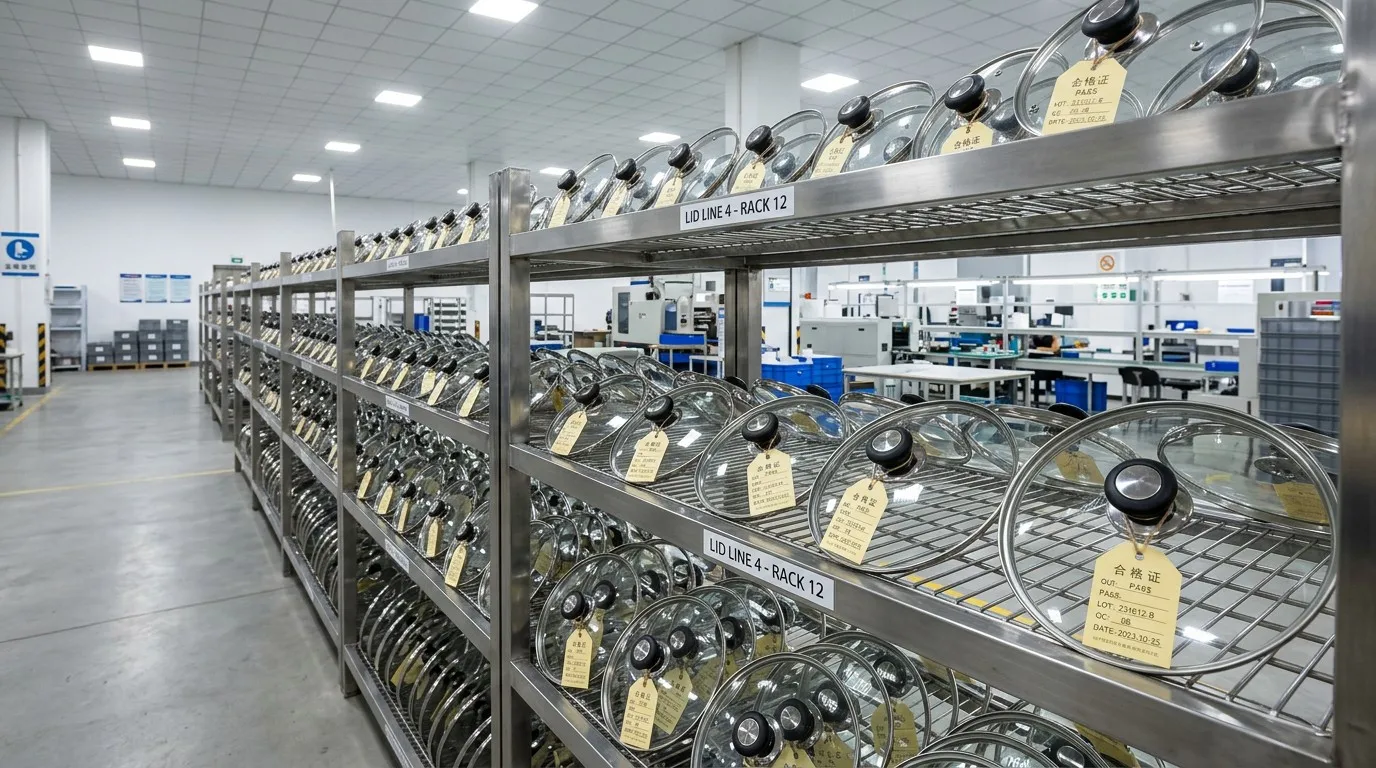
Tempering cycle duration: The physical requirement for 4 mm glass to achieve sufficient surface compressive stress (minimum 90 MPa for toughened glass per EN 12150) is a furnace cycle of 3.5–4.5 minutes. Factories that run shorter cycles to increase throughput produce glass that passes visual inspection but fails thermal shock testing. Ask for a recent furnace pyrometer log showing time-temperature profiles per production batch. A factory that cannot produce this within 2 business days is not running a documented quality system.
AQL 2.5 inspection records: ISO 2859-1 AQL 2.5 sampling means inspecting a statistically defined sample from each production lot for visual defects (bubbles, rim scratches, chips), dimensional conformance (diameter ±0.5 mm, rim straightness ±0.3 mm), and functional checks (knob torque, lid seating). Request the inspection record from the most recent three production lots. Consistent pass rates above 98% indicate a stable process; pass rates below 96% indicate either a quality problem or inadequately stringent inspection criteria.
2. Compliance Documentation: The Three-Layer Stack for US and EU Markets
Compliance for exported tempered glass lids operates in three layers, each addressing a different regulatory requirement. A qualified supplier must be able to provide documentation for all three layers within 5 business days of a serious inquiry:
| Layer | Requirement | Document | Validity |
|---|---|---|---|
| Product safety | EN 12983-1 thermal shock; EN 12150 glass strength | Test report from accredited lab (SGS, Intertek, TÜV) | 3 years or on spec change |
| Food contact | FDA 21 CFR 177.2410 (glass) + rim metal migration; LFGB §31 (EU) | Compliance letter + migration test report | 2 years or on material change |
| Social compliance | Labour and environmental standards (EU CSDDD, UK Modern Slavery Act) | BSCI audit report or Sedex membership + SMETA audit | 1–2 years (facility level) |
A supplier that has product safety documentation but lacks food contact compliance is not export-ready for US or EU retail. A supplier with food contact compliance but no social compliance documentation is increasingly ineligible for major EU retail buyers following CSDDD enforcement beginning in 2027 for companies above €150M revenue. Build all three layers into your supplier qualification checklist from day one.
One practical verification step: request that the supplier send you the test report cover page and sample identification section (not the summary conclusion) for their most recent LFGB test. The cover page shows the testing laboratory (verify it is accredited), the test date, the specific product description, and the material designation. This takes 30 seconds to check and immediately separates suppliers with current, product-specific test reports from those recycling old documentation for different product configurations.
3. FOB Price Architecture: Understanding What You Are Actually Comparing
When comparing FOB quotes from multiple tempered glass lid suppliers, the price per unit is not a valid comparison point unless the specification basis is identical. Five factors create legitimate price differences between quotes for nominally the same product:
- Glass thickness: 3.5 mm vs 4 mm adds approximately ¥0.30–0.50/unit in raw material cost. Quotes using thinner glass appear cheaper but are non-compliant.
- Stainless steel grade: 304 vs 430 adds ¥0.20–0.35/unit. 430 grade is standard in the value tier; 304 is required for premium retail programmes and LFGB nickel migration compliance.
- Factory-direct vs trading company: Trading companies typically add 15–25% above factory cost. A factory-direct quote at $2.20 and a trading company quote at $1.95 may represent the same underlying factory cost — the trading company sourcing from a lower-quality factory at lower specification.
- Compliance cost amortisation: Factories with current FDA, LFGB, and BSCI certification amortise approximately $0.03–0.08 per unit in compliance overhead. Uncertified factories appear cheaper by exactly that margin.
- Packaging specification: Standard export packaging (cardboard + foam wrap) vs retail-ready packaging with colour print adds $0.40–1.80/unit.
The correct comparison method: send all candidate suppliers the same specification sheet (glass thickness, steel grade, knob type, packaging specification, compliance requirement) and compare responses on a like-for-like basis. Request an itemised BOM from each — raw materials, conversion, compliance, packaging, margin — and flag any quote that does not break down to at least four cost elements as potentially hiding a specification compromise.
4. Boyu Glass Factory Direct Advantage
Boyu Glass (glasslidfactory.com) provides procurement teams with itemised BOM breakdowns on request, current FDA/LFGB/BSCI documentation deliverable within 3 business days, and per-lot pyrometer logs as standard QC documentation. Our 4 mm 304-grade lid programme has been continuously certified since 2019, with annual LFGB renewal through SGS Ningbo. MOQ is 1,000 pieces per SKU; FOB Ningbo lead time is 45 days from confirmed PO.
Frequently Asked Questions
How many suppliers should I qualify before selecting a primary source?
For a new glass lid programme, qualify a minimum of three suppliers through RFQ + sample stage, and two through production trial. This provides a qualified backup supplier before you are dependent on a primary, and gives you comparative data on quality consistency, communication responsiveness, and documentation completeness — all of which are harder to assess from RFQ responses alone.
What is the fastest way to verify that a Chinese glass lid supplier is a real factory, not a trading company?
Request a video call on the factory floor, specifically asking to see the tempering furnace in operation and the AQL inspection station with current lot documents visible. A trading company cannot stage this. Additionally, verify the business licence (营业执照) registered address matches the production facility location — trading companies often register at a commercial address separate from the factory they source from.
Should I use a third-party inspection agent for glass lid shipments?
Yes, for first and second orders from any new supplier. Third-party pre-shipment inspection (PSI) by SGS, Intertek, or QIMA costs approximately $250–400 per inspection and takes 1–2 days. It provides an independent AQL 2.5 check against your specification sheet, catches most quality issues before goods are loaded, and creates a documented quality record that is useful if a dispute arises. After three consecutive passed PSIs from the same factory, you can evaluate whether to shift to periodic or random inspection.
Related B2B Sourcing Guides
Continue reading on related sourcing topics for cookware brands and importers:
Conclusion
Three key takeaways for procurement teams evaluating tempered glass lid suppliers:
- Quality and compliance are not separable evaluation criteria. A supplier with excellent AQL records but no LFGB documentation is not compliant for EU retail. A supplier with current LFGB reports but no pyrometer logs cannot demonstrate that the documented specification matches actual production. Evaluate quality systems and compliance documentation as a unified package.
- Price comparison requires specification alignment. Sending different suppliers different specifications and comparing the resulting quotes is not price benchmarking — it is noise. Standardise your specification sheet across all RFQs and require itemised BOM responses to make quotes genuinely comparable.
- Third-party inspection is not optional for new supplier relationships. The cost of one PSI ($250–400) is recoverable from a single avoided quality claim. Build it into the purchase order terms as a standard condition for the first three production lots.
Ready to source factory-direct? Request a free quote within 24 hours: aman098@126.com or visit glasslidfactory.com